Across the country, dementia experts have spent decades developing evidence-based techniques for supporting people living with Alzheimer's disease and related dementias and the family members who care for them. Health systems have built programs. Dementia navigators guide families through increasingly complex care journeys. Organizations have created extensive libraries of caregiver education. Through initiatives such as the CMS GUIDE Model, the federal government has established important frameworks for coordinated dementia care and caregiver support.
And yet, somewhere tonight, a family caregiver may be standing in a kitchen at 8:30 facing a situation they knew would eventually come but never felt fully prepared for. Their loved one is confused, agitated, refusing to eat, or trying to leave the house. The caregiver remembers talking about this with someone - a navigator, a clinician, perhaps a video they watched after an appointment.
"What did they tell me to do when this happens?"
That question exposes one of the most important gaps in dementia care. It is not necessarily a lack of expertise. It is the distance between what our experts know and what a caregiver can understand, retain, find, and use at the moment it matters.
Information delivered is not necessarily information understood. Information understood once is not necessarily remembered when it is needed. And information remembered is not necessarily acted upon.
That distinction matters because so much of dementia care happens outside the walls of a healthcare organization - in kitchens and bedrooms, grocery stores and cars, at 2:00 in the afternoon and 2:00 in the morning. The professional is often not standing beside the caregiver when the next decision has to be made.
If the expertise already exists, why isn't it consistently reaching caregivers at the moment they need it?
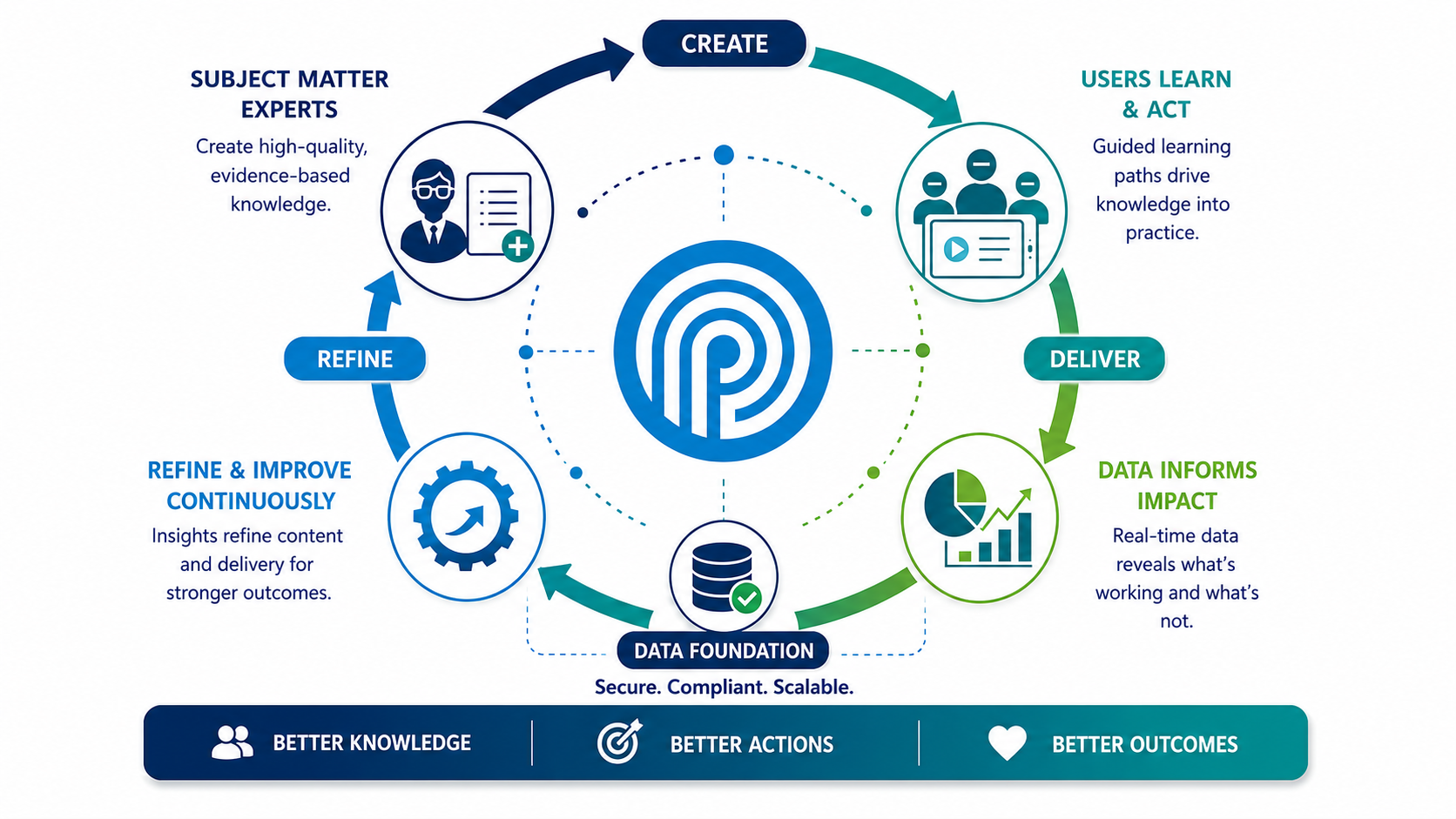
Perhaps the next advancement in caregiver education is not simply creating more information. Perhaps it is building the missing layer between expert guidance and caregiver action: infrastructure that structures what our best experts already know, makes it available as needs change, and allows us to measure whether that guidance was actually understood and used.
Dementia navigators are the human backbone of many dementia programs. As they are on the front lines with families, they develop something difficult to capture in a traditional clinical record: an understanding of where a family is in its journey.
They know what has been explained, what the caregiver is struggling with, which techniques have been introduced, what questions have already been asked, and what may need reinforcement next.
But what happens when that navigator leaves?
Staff turnover is a reality in healthcare. People change roles, caseloads are reassigned, and new navigators inherit families they may never have met. Clinical notes can tell the next navigator a great deal about the patient, but they may not clearly show what the caregiver has actually been taught, which educational resources were provided, whether those resources were used, what the caregiver understood, or where gaps remain.
If much of the education happened orally, the new navigator may be left reconstructing the family's educational journey from notes, conversations, and memory. That creates a second missing layer in dementia care: organizational memory.
Imagine instead that every family has an ongoing, structured learning path connected to its care journey. When a technique is introduced, it becomes part of that path. When education is assigned, it is documented. When a caregiver watches a video, reads guidance, completes a knowledge check or assessment, or returns to information months later, that engagement becomes part of a longitudinal record.
A new navigator no longer has to begin by asking, "What did the previous navigator tell you?" They can see where the family has been, what has been delivered, what has been engaged with, what has been understood, and what may need reinforcement.
The goal is not to replace the relationship between a dementia navigator and a family. It is to protect that relationship with infrastructure.
People will change. Navigators will change. Care needs will change. The infrastructure connecting the family to the knowledge, education, and care plan should remain.
One of the great opportunities in dementia care is that we do not have to start from scratch. Some of the world's leading experts have already developed techniques that help families navigate the realities of the disease.
Positive Approach to Care® (PAC™), founded by internationally recognized dementia care educator Teepa Snow, offers a powerful example. Teepa Snow is one of the most trusted voices in dementia care, and her innovative techniques have shaped how professionals and family caregivers worldwide understand and respond to this condition. PAC's Goodson Library reflects that expertise at scale: more than 140 dementia care technique videos, built from decades of hands-on clinical experience, designed to help professionals and families respond to real situations throughout the dementia journey. This video library contains a wealth of practical expertise, addressing topics such as communication, behavior, safety, daily activities, changing abilities, and other challenges.
Return to the caregiver in the kitchen at 8:30. The right technique may already exist. The question is whether the caregiver can find, understand, and use it, and return to it later.
Even a library this rich delivers the most value when it meets a family at the right moment. Organized into a structured path reflecting where that family is in its journey, PAC's expert content can reach caregivers exactly when it is most useful. A navigator can introduce the right technique at the right time. The caregiver can work through it step by step, return to it when needed, and receive new education as the disease progresses.
This is not a theoretical model. At the Riverside Health’s Martha W. Goodson Center at, Executive Director Danielle Cannella is putting it into practice, structuring the Goodson Library into a guided path for the caregivers her team serves. Rather than pointing families to a library and hoping they find their way, her navigators can introduce the right technique at the right moment and see how families engage with it over time.
At the same time, the organization can begin to understand what happened after the information was delivered: Was it opened? Completed? Understood? Revisited? Where did the caregiver struggle? What might they need next?
This changes education from a library sitting beside the care model into part of the care journey itself. Over time, the caregiver builds a personal knowledge base for caring for someone they love - one that does not disappear when a navigator changes and does not depend on remembering everything said during a clinical visit.
We do not always need more content. Sometimes we need a better way for the best content to reach its audience.
If caregiver education should be more than a conversation, handout, or link to a video or library, then we have to ask a harder question: Can we measure whether education actually changes what happens next?
PATHS and LifeCare for Seniors are beginning to explore this question through an IRB-approved dementia caregiver case study based on the CMS GUIDE Model. Architected by Dr. Lee Fleisher and his team at Rubrum Advising, the study is enrolling approximately 45 dementia caregivers in a structured PATHS journey that includes informed consent, knowledge assessment, caregiver burden and quality-of-life measures, healthcare utilization, and care plan adherence.
The study is underway, so we do not yet know what the results will show. But its design represents an important shift. Instead of asking only, "Did we provide the education?" we can begin asking whether the caregiver engaged with it, understood it, gained knowledge or confidence, followed the care plan, and experienced changes in burden or healthcare utilization.
GUIDE gives organizations a framework for coordinated dementia care. The opportunity now is to build a documentation and measurement layer around that framework.
Healthcare is extraordinarily good at documenting clinical activity: appointments, prescriptions, tests, emergency visits, and hospital admissions. Caregiver education is much harder to see, evaluate, and manage. A note may tell us education was provided; a checkbox may tell us instructions were given. But those are imperfect proxies for what we really want to know:
Did knowledge successfully travel from the expert to the caregiver and become something the caregiver could use?
Structured education makes that journey more visible. If education is delivered through a path in a series to nimble steps, engagement can be documented. If comprehension is assessed, understanding can begin to be measured. If the caregiver returns to information later, that becomes part of the longitudinal picture.
The goal is not more data. It is better care. Measurement can help navigators see where a family needs support, help organizations identify recurring gaps, help experts refine education, and help policymakers understand whether caregiver education is actually reaching the home and strengthening the care plan.
If dementia care is moving toward coordinated, longitudinal models, caregiver education should evolve with it. The standard can no longer simply be whether information was provided. We should begin asking whether it made the entire journey from the expert to the home.
Five principles can help shape that next generation of caregiver support:
1. Add a documentation and measurement layer. When HHS, CMS, health systems, or other organizations establish caregiver education standards, there should be a corresponding way to document whether the education reached the caregiver and was understood. Good infrastructure should create that record naturally rather than add another administrative burden.
2. Give caregivers something they can return to. Human interaction should remain at the center of dementia navigation, but a conversation should not be the endpoint. Education should leave behind something structured, accessible, revisitable, and visible to the next navigator.
3. Scale the expertise we already have. Before building another curriculum or content library, we should ask whether proven expertise could simply be delivered better. The opportunity is to give our best experts and navigators infrastructure capable of extending their reach.
4. Make care plan adherence more visible. Structured education cannot capture every complexity of caregiving, but it can provide useful signals about where caregivers engage, struggle, or may need additional human support. Measurement should not replace professional judgment; it should help professionals know where their attention is needed most.
5. Let caregiver education grow with the disease. Dementia is progressive, and caregiver education should be progressive too. New knowledge should layer onto existing knowledge, previous techniques should remain accessible, and new navigators should be able to understand where the family has been. The family is not simply completing training; they are building capacity to care.
Let's return one last time to that kitchen at 8:30 at night.
The navigator isn't there. The physician isn't there. The dementia expert isn't there. A family caregiver is.
But this time, the caregiver does not have to rely solely on memory. They know where to go. They can return to the guidance their navigator introduced weeks or months earlier, revisit the technique, and build on what they have already learned.
When they speak with their navigator again, the navigator can see what was provided, what the caregiver engaged with, what was understood, where they may be struggling, and what they may need next. If that navigator leaves, the family's journey does not leave with them.
As HHS considers the update to the National Plan to Address Alzheimer's Disease, there is an opportunity to expand how we think about caregiver education and support. We already have extraordinary experts, trusted navigators, health systems, community organizations, and federal models such as GUIDE. The next opportunity is to connect them with infrastructure that protects continuity and helps knowledge complete its journey into the home.
Technology should not replace dementia navigators; it should make them more effective. Measurement should not replace professional judgment; it should help professionals identify where their attention is needed. Structured education should not replace trusted human conversations; it should make the value of those conversations last.
Ultimately, the measure of dementia education should not simply be whether we told a caregiver what to do. It should be whether, at 8:30 at night when no one else is there, they know what to do next.
Context: This article grew from PATHS' response to HHS Request for Information, Docket HHS-ASPE-2026-0298, regarding the update to the National Plan to Address Alzheimer's Disease.