


The Learning Health System Has a Theory.PATHS Is the Engine.
For two decades, healthcare has described a system that learns from every patient. PATHS turns that idea into something that runs, every day, in every journey.
Watch how PATHS closes the loop between what we know and what we do.
An Idea Twenty Years in the Making.
In 2006, the Institute of Medicine convened a roundtable around a simple ambition: a health system where every patient's care adds to what we know, and what we know reaches every patient. Its 2013 report, Best Care at Lower Cost, called for continuous learning built into the everyday work of care.1,2
The field describes the loop in three movements: practice becomes data, data becomes knowledge, and knowledge returns to practice.3

The Hardest Step Is the Last One.
It has been estimated that research takes an average of 17 years to become routine practice.4 A 2021 report on learning health systems found that delivering knowledge into clinical work is still "slow and variable."3
The same report lists training and feedback among the strategies that can help put knowledge into practice, and says the skills a learning workforce needs take many years to build.3 The theory is sound. What has been missing is a dependable way to carry knowledge to people and know what happened next.
The Learning Health System Is More Than a Theory. It Needs an Engine.
You can have a perfect theory of reaching the moon, but without a rocket you never leave the ground. And once you launch, mission control doesn't guess where the rocket is. Telemetry tells them.
PATHS is that engine and that telemetry. It carries knowledge to patients, caregivers, and care teams as structured journeys, and it reports back what actually happened along the way.
Passive Knowledge of What Happens in Care.
Every journey on PATHS records itself as it happens: who started, which Steps they completed, what they understood, what they signed, and where they stopped. No one fills out an extra report to create that record.
That record helps everyone involved understand who they serve and what they do. Patients and caregivers see their progress. Care teams see who needs help before the next visit. Leaders see patterns across populations. Researchers see real-world evidence of what knowledge reached practice.
Every Journey Creates an Opportunity to Improve the Next.
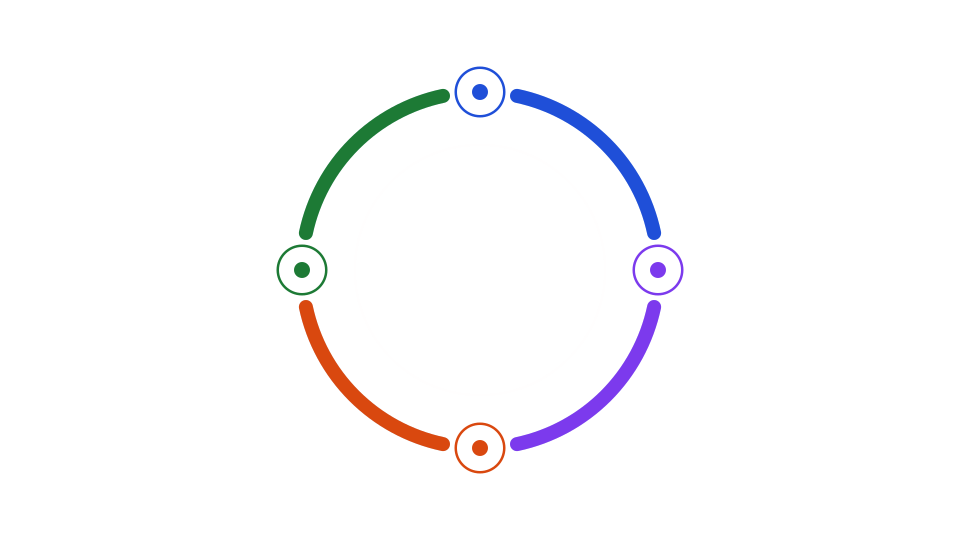

| PATHS stage | What happens | LHS movement |
|---|---|---|
| CREATE | Clinical and organizational knowledge becomes structured journeys | LHS movement: Knowledge to Practice |
| ENGAGE | Patients, caregivers, and staff learn, act, and participate | LHS movement: Practice |
| KNOW | Engagement, assessments, and progress are captured as they happen | LHS movement: Practice to Data |
| IMPROVE | Insights refine guidance, workflows, and the next journey | LHS movement: Data to Knowledge |
One Engine. Every Kind of Health System.
Academic health systems
connect the research, education, and clinical missions with a shared record of what knowledge reached patients and staff, and how it performed.5
Community health systems
bring structured education and documentation to the populations they serve, without adding staff time, and contribute to what the field learns from real-world care.
Already Running.
Proof in Practice: Measurable Learning.

In an Arizona fentanyl prevention education pilot, more than 2,000 participants, including 1,740 students, parents, and teachers, engaged with the curriculum across four high schools, completing more than 31,000 Steps. The study demonstrated statistically significant knowledge improvement (p < .001), showing how PATHS can measure learning and help organizations understand the impact of their educational programs.
Source: STOP IT! Pilot, 2025–2026. Explore the Results (PDF download)
The hospital reports that the same GUIDE Path featured on the Social Work & Navigation page saves about 45 minutes on each GUIDE submission to CMS.7
Social Work & NavigationSources
- 1.Institute of Medicine. The Learning Healthcare System: Workshop Summary. National Academies Press; 2007.
- 2.Institute of Medicine. Best Care at Lower Cost: The Path to Continuously Learning Health Care in America. National Academies Press; 2013.
- 3.Foley T, Horwitz L, Zahran R. Realising the Potential of Learning Health Systems. The Learning Healthcare Project, Newcastle University; May 2021.
- 4.Balas EA, Boren SA. Managing clinical knowledge for health care improvement. Yearbook of Medical Informatics 2000:65-70.
- 5.Rosenthal GE, et al. The Academic Learning Health System: A Framework for Integrating the Multiple Missions of Academic Medical Centers. Academic Medicine 2023;98(9):1002-1007. PMC10453356.
- 6.Huff, Renszel, Farmer, Sharma, Leone, Shanahan, Fowler, Geyer. STOP IT! Knowledge Saves Lives: Evaluation of a Pilot Fentanyl Education Initiative for Students, Parents, and Educators. A rural school district in southern Arizona, 2025-2026 school year. July 25, 2026.
- 7.Hospital-reported time savings on GUIDE submissions to CMS.
Learn From Every Patient. Improve Every Journey.
Start with one journey that matters to your organization. Let it run, see what it teaches you, and use that knowledge to improve the next one.
Better Knowledge | Better Documentation | Better Practice