




Medical Specialties

Before dementia care support can begin, families are asked to share health, social, and caregiving information. Gathering it usually takes appointments, phone calls, and paper forms.
PATHS helps healthcare organizations turn social work expertise into guided family journeys, giving caregivers clear steps while giving social workers visibility into what has been completed, understood, and signed.
Families caring for someone with dementia are asked to complete several forms before support begins. Every hour a social worker spends collecting and retyping answers is an hour not spent helping families.
7.2M1
Americans age 65 and older living with Alzheimer's dementia
~12M1
Family members and other unpaid caregivers of people living with dementia
19.2B1
Hours of unpaid dementia care provided in 2024
An estimated 7.2 million Americans age 65 and older live with Alzheimer's dementia, supported by nearly 12 million family members and other unpaid caregivers. In 2024 those caregivers provided about 19.2 billion hours of unpaid care, valued at about $413 billion.1
Medicare's GUIDE Model, launched July 1, 2024 for an eight-year run, supports dementia care navigation, caregiver training, and respite. Enrollment begins with information gathering, including assessments of the person living with dementia and of the caregiver's needs and strain. When intake happens in person or by phone, social workers schedule visits, walk families through each form, and retype answers into records.2,3,4,5,6
At one hospital using a PATHS GUIDE enrollment Path, families finish in about 9 minutes, based on PATHS timestamps. The hospital reports saving about 45 minutes of social worker time on each GUIDE submission to CMS by removing scheduling, in-person paperwork, and retyping. This is one hospital's experience, not a controlled study. Each organization supplies its own time and cost assumptions.7
Food, housing, disability, dementia care, disaster relief. Each program has its own forms, rules, and signatures, and families rarely need just one.
14 programs. Each with its own forms. One family.
One guided Path at a time.
Illustrative. Representative rules and forms vary by state and program.
Social workers have a critical responsibility to prepare families for what comes next. But once families leave the office, how do we know they're ready?
Did they complete every required form? Do they understand what the program offers? Have they signed what they need to sign? Where do they need a social worker's help?
Gathering information is essential. Knowing what families completed, and where they got stuck, lets social workers spend their time where it matters most.
Education and knowledge
Help caregivers understand the program, what enrollment involves, and why each form matters.
Tasks, decisions, follow-through
Guide caregivers through each required form at home, on their phone, in their own time.
Forms, signatures, next steps
Keep enrollment forms, signatures, and next steps together in one journey.
Assessments and engagement evidence
Show social workers what was completed and signed, and where follow-up is needed.
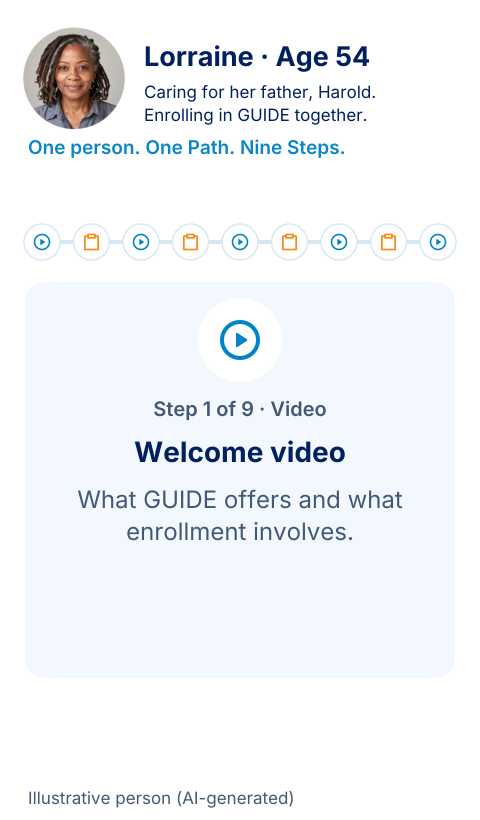
Follow Lorraine, who cares for her father, Harold, through an illustrative nine-Step Path. A GUIDE program could use this structure to explain enrollment, collect each required form at home, and hand the results to its social work team.
The Steps alternate a short video with the form it introduces, mirroring the live GUIDE enrollment Path:
Illustrative person (AI-generated). Illustrative educational Path. Completing the Path does not establish eligibility or enrollment.
what the GUIDE program offers, what enrollment involves, and that Lorraine creates an account before she starts.
housing, food, transportation, and other needs that shape the care plan.
why questions about Harold's health help the care team plan support.
a short, standard measure of overall physical and mental health.
caring for the caregiver, and why the team asks how Lorraine is doing.
how caregiving is affecting Lorraine's life.
the last form, and what happens after she finishes.
the program's short caregiver survey, with Lorraine's signature.
what happens next. The GUIDE program team reviews her answers, confirms eligibility, and submits enrollment to Medicare.
Experience the GUIDE enrollment Path the way a family would. Open it on your phone or scan the code. You'll create a free account before you start.
This is a demonstration Path. Please don't enter real health information.
Assign a value to the CMS GUIDE Enrollment Path and see the results.
How many times your team already does this workflow each year.
65.5staff hours saved per year
$2,291estimated value per year
Change the assumptions above to see your estimate of time and money saved.
CREATE
Social workers turn the enrollment process they walk through with every family into a structured Path and assign it a value of 21 minutes of staff education time saved per patient.
ENGAGE
Each year, 187 caregivers like Lorraine complete GUIDE enrollment at home with the CMS GUIDE Enrollment Path, saving 21 minutes of education time each.
KNOW
That adds up to 3,927 minutes (65.5 hours) of staff time, worth an estimated $2,291 a year at $35.00 an hour.
IMPROVE
Engagement, form answers and questions show where the enrollment steps were clear or confusing, so the team can refine them for the next family.
Every Social Work & Navigation Journey Creates an Opportunity to Improve the Next.
Estimates are illustrative and use the assumptions above. They are not measured results.
What begins with Harold's referral to the GUIDE program leads to more than one Path. From enrolling in GUIDE to his assessment visit, his care plan, caregiver support, community resources, a difficult night, respite care and check-ins as Harold's needs change, Lorraine needs guidance at every stage. PATHS connects multiple Paths into an experience tailored to her changing needs, and each Path could save the care team time, not only the first. This journey is illustrative.
Lorraine's care for her father doesn't stop at one Path. After enrollment, the social work team could provide a Path for each part of the journey: caregiver support, community resources, care planning, and check-ins as Harold's needs change. Each Path Lorraine completes also shows the team what she engaged with, what she understood and what she still had questions about.
Lorraine finds support for the demands of caring for her father. How caregivers respond helps the team see who may need more help, and sooner.
Lorraine explores the services the team selected for Harold's needs. The barriers families report show where social work support is needed.
Lorraine shares how things are going as Harold's needs change. That helps the team update the care plan as things change.
The more the health system knows about each patient's experience and journey, the better it can make its workflows. What Lorraine and every other caregiver engage with, understand and ask about becomes health system intelligence: the team learns from every patient and refines each Path, so the next patient's experience is better. Clearer Paths mean fewer repeat calls and less time re-teaching the same education, and that saves time and money across the health system.
Medical Specialties

Cardiovascular

Neurosciences
Neurosciences
Cancer

Neurosciences
1–6 of 25
Improving social work support doesn't require changing every workflow at once. Start with an enrollment journey that matters to your organization, see how families engage, and use what you learn to improve the experience.