



Medical Specialties

A new epilepsy diagnosis can raise questions about treatment, medication, safety, and everyday life.
PATHS helps healthcare organizations turn clinical expertise into actionable patient journeys, giving patients and caregivers clear guidance while providing care teams with visibility into engagement, understanding, and progress.
3.4M1
Americans living with active epilepsy (2015)
$24.5B6
added U.S. health care spending each year from epilepsy and seizures
86%8
more hospital admissions during periods of missed seizure medication
Much of that care reaches staff as phone calls. In one U.S. epilepsy program, a nurse coordinator spent about 14 hours a week on patient calls, mostly refills and education, largely unreimbursed. A 2025 study at one Swedish epilepsy center found only 19% of contacts were in-person visits; nurses handled 44% of contacts, mostly by phone.4,5
Epilepsy and seizures add an estimated $24.5 billion a year to U.S. health care spending, and costs run markedly higher when seizures are uncontrolled. Periods of missed seizure medication have been tied to 50% more ED visits, 86% more hospital admissions and more than three times the risk of death. CDC estimates SUDEP takes about 1 in 1,000 adults with epilepsy each year, with uncontrolled seizures a main risk factor.6,7,8,9
In a randomized trial, high-risk adults in a self-management program had fewer negative health events, such as seizures, ED visits and hospitalizations, plus better quality of life and lower depression scores. At one children's hospital, seizure action plan use rose above 90%, and ED visits among established epilepsy patients fell from 10.2 to 7.5 per 1,000. These findings concern staffed programs, and the hospital comparison does not establish causation. A Path could organize education and the action plan selected by the care team.10,11
Healthcare teams have a critical responsibility to educate and prepare patients for that journey. But once patients leave the clinical setting, how do we know they're ready?
Do they understand their care plan? Can they apply what they've learned? Are they following through? Where do they need additional support?
Preparing patients for the journey is essential. Knowing how they're managing it creates the opportunity to improve care.
PATHS has supported the development of structured epilepsy education and assessment resources designed to help patients navigate important aspects of their care.
These resources demonstrate how clinical knowledge can be organized into actionable Paths, with opportunities to assess understanding and capture engagement.
Education and knowledge
What epilepsy means, what to expect and which questions to ask, in videos and documents patients and families can revisit at any time.
Tasks, decisions, follow-through
A seizure action and emergency plan, so patients and the people around them know what to do and when to seek help.
Medications, appointments, self-care
Medication education, adherence reminders, questions about side effects and preparation for each follow-up visit.
Assessments and engagement evidence
Short assessments show what patients and caregivers understand about safety, medications and the care plan.
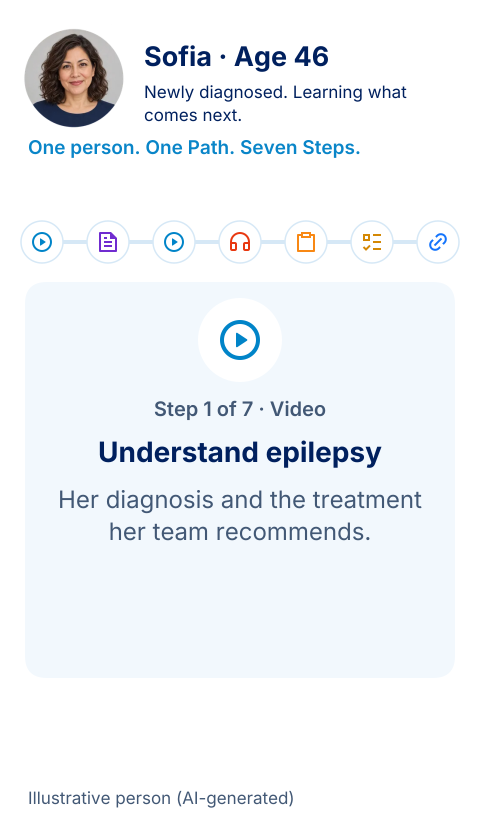
Follow Sofia through an illustrative seven-Step Path. A hospital could use this structure to organize education selected by its care team, help people prepare questions and connect them with follow-up and support.
Understanding My Epilepsy Diagnosis Path
Illustrative person (AI-generated). Illustrative educational Path. Completion does not establish a clinical outcome.
Learn about Sofia’s diagnosis and the treatment her neurology team recommends.
Keep first-aid steps, emergency contacts and any prescribed rescue-medicine instructions together.
Learn how others can keep someone safe without restraint or putting anything in their mouth.
Revisit the team’s medicine schedule and discuss side effects with the team before any change.
Sofia prepares seizure notes and questions for her next care-team conversation.
Practice recognizing seizure emergencies, including prolonged seizures or trouble breathing.
Find neurology follow-up details and self-management resources selected by the team.
Assign a value to the Understanding My Epilepsy Diagnosis Path and see the results.
How many times your team already does this workflow each year.
65.5staff hours saved per year
$2,291estimated value per year
Change the assumptions above to see your estimate of time and money saved.
CREATE
Neurology clinicians turn the education they repeat with every newly diagnosed patient into a structured Path and assign it a value of 21 minutes of staff education time saved per patient.
ENGAGE
Each year, 187 patients like Sofia learn about a new epilepsy diagnosis with the Understanding My Epilepsy Diagnosis Path, saving 21 minutes of education time each.
KNOW
That adds up to 3,927 minutes (65.5 hours) of staff time, worth an estimated $2,291 a year at $35.00 an hour.
IMPROVE
Engagement, knowledge checks and questions show where epilepsy education was clear or confusing, so the care team can refine it for the next patient.
Every Epilepsy Journey Creates an Opportunity to Improve the Next.
Estimates are illustrative and use the assumptions above. They are not measured results.
Sofia's care doesn't stop at one Path. After her diagnosis, the health system could provide a Path for each part of her care: understanding epilepsy, her seizure action plan, seizure first aid for the people around her, her medicine routine, and follow-up. Each Path Sofia completes also shows her care team what she engaged with, what she understood and what she still had questions about.
Sofia shares seizure first aid with family and coworkers. Knowledge checks show the team which safety steps need clearer teaching.
Sofia can revisit her team's medicine schedule whenever she needs it. The questions patients ask about side effects show where the guidance needs work.
Sofia arrives at follow-up with her seizure notes and questions ready. That helps the team focus the visit on her care.
The more the health system knows about each patient's experience and journey, the better it can make its workflows. What Sofia and every other patient engage with, understand and ask about becomes health system intelligence: the team learns from every patient and refines each Path, so the next patient's experience is better. Clearer Paths mean fewer repeat calls and less time re-teaching the same education, and that saves time and money across the health system.
Medical Specialties

Cardiovascular

Neurosciences

Cancer

Neurosciences

Surgery
1–6 of 25
Improving epilepsy care doesn't require changing every workflow at once.
Start with a patient journey that matters to your organization. Build a structured approach, understand how patients and caregivers engage, and use what you learn to improve the experience.