



Medical Specialties

Patients need to understand a sequence of instructions before an operation, while managing practical arrangements and questions about what comes next.
PATHS helps healthcare organizations turn clinical expertise into actionable patient journeys, giving patients and caregivers clear guidance while providing care teams with visibility into engagement, understanding, and progress.
Patients need to understand a sequence of instructions before an operation, while managing practical arrangements and questions about what comes next. The surgical team sets those instructions for each person.
1.23%4
Day-of-surgery cancellations among elective cases at one U.S. hospital, January to May 2013
~½ day2
Shorter hospital stay after psychological preparation in a 2016 review, with low-certainty evidence
Preparation combines individual medical instructions with practical arrangements. At one U.S. hospital from January to May 2013, 183 of 14,893 elective cases were cancelled on the day of surgery. New medical conditions were the most common reason; cancellation is not always a failure to follow instructions.1,4
In that hospital's preoperative service, staff reviewed history and medicines, obtained records, arranged tests and consultations, and explained preparation. Some patients received nurse telephone screening; others needed a comprehensive clinical assessment. This coordination takes professional time beyond sending instructions.4
A cancellation disrupts a planned operation and the operating-room schedule. The study recorded both medical and non-medical reasons, so clear education cannot prevent every delay. Questions about illness, medicines or preparation still need review by the surgical team.1,4
A Cochrane review found possible reductions in pain, distress and length of stay after psychological preparation, with low-quality evidence. A separate hip and knee replacement review found no clear added benefit from education over usual care. Staffed assessment and preparation need clinical judgment; these studies do not establish PATHS outcomes.2,3
Healthcare teams have a critical responsibility to educate and prepare patients for that journey. But once patients leave the clinical setting, how do we know they're ready?
Do they understand their care plan? Can they apply what they've learned? Are they following through? Where do they need additional support?
Preparing patients for the journey is essential. Knowing how they're managing it creates the opportunity to improve care.
Education and knowledge
Explain what the surgical team wants the patient to know about the planned procedure.
Tasks, decisions, follow-through
Help patients work through preparation guidance and questions selected by their care team.
Medications, appointments, self-care
Keep the team's instructions and appointment preparation available to patients and caregivers.
Assessments and engagement evidence
Use assessments to check understanding before the procedure and identify questions for follow-up.
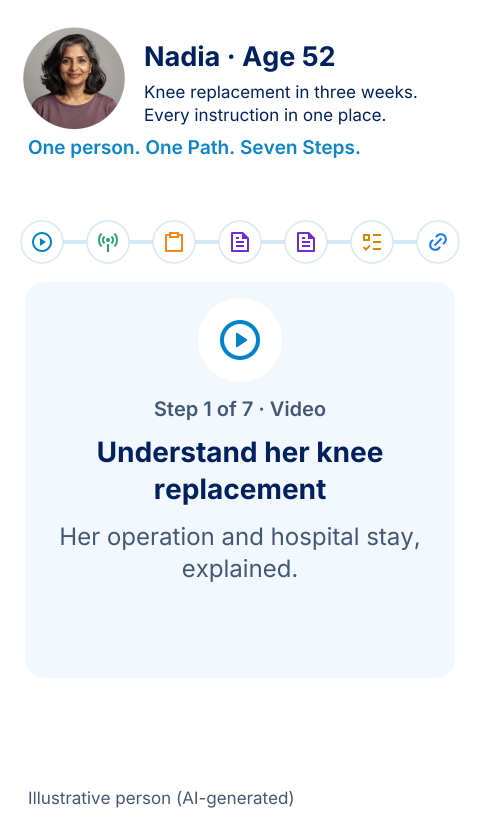
Follow Nadia, who has a total knee replacement planned, through an illustrative seven-Step Path. A hospital could use this structure to organize the instructions its surgical team selects, gather preassessment answers ahead of time and help patients arrive prepared.
Preparing for Total Knee Replacement Surgery Path
Illustrative person (AI-generated). Illustrative educational Path. Completion does not establish a clinical outcome.
Her surgical team explains what happens during a total knee replacement, the anesthesia they may discuss with her, and what to expect from her hospital stay.
A live online session where members of her surgical and anesthesia team introduce themselves and answer questions before the day of surgery.
Nadia shares her health conditions, past operations, medicines, allergies and any past problems with anesthesia, and adds her own questions, for the team to review before her visit.
Her surgical team’s written instructions on which of her medicines and supplements to take or pause before surgery, kept where she can revisit them.
A checklist for a responsible adult to drive her home, and for help with meals, shopping, bathing and laundry in the first weeks after surgery.
Practice the steps her team gave her: when to stop eating and drinking, which medicines to take that morning, how to wash her skin, and to call the surgeon’s office if she feels unwell.
Where to go, when to arrive, what to bring, such as her medicine list, insurance card and any walker her team asked for, and the number to call if her plans change.
Assign a value to the Preparing for Total Knee Replacement Surgery Path and see the results.
How many times your team already does this workflow each year.
65.5staff hours saved per year
$2,291estimated value per year
Change the assumptions above to see your estimate of time and money saved.
CREATE
Preoperative nurses turn the preparation teaching they repeat with every joint replacement patient into a structured Path and assign it a value of 21 minutes of staff education time saved per patient.
ENGAGE
Each year, 187 patients like Nadia prepare for knee replacement surgery with the Preparing for Total Knee Replacement Surgery Path, saving 21 minutes of education time each.
KNOW
That adds up to 3,927 minutes (65.5 hours) of staff time, worth an estimated $2,291 a year at $35.00 an hour.
IMPROVE
Engagement, knowledge checks and questions show where the preparation guidance was clear or confusing, so the care team can refine it for the next patient.
Every Preoperative Care Journey Creates an Opportunity to Improve the Next.
Estimates are illustrative and use the assumptions above. They are not measured results.
Nadia's care doesn't stop at one Path. Before her knee replacement, the hospital provides a Path for each part of getting ready: preparing for surgery, meeting her surgical team, her preassessment, her medicine instructions, and arrival day. Each Path Nadia completes also shows her care team what she engaged with, what she understood and what she still had questions about.
Nadia can revisit her individual medicine instructions whenever she needs them. The questions patients ask show which instructions need work.
Nadia has her team's instructions organized by the dates that matter. The steps patients miss show the team where the checklist can be clearer.
Nadia knows where to go and what to bring. Knowing where patients get stuck helps the team prevent surprises on the day of surgery.
The more the health system knows about each patient's experience and journey, the better it can make its workflows. What Nadia and every other patient engage with, understand and ask about becomes health system intelligence: the team learns from every patient and refines each Path, so the next patient's experience is better. Clearer Paths mean fewer repeat calls and less time re-teaching the same education, and that saves time and money across the health system.
Medical Specialties

Cardiovascular

Neurosciences

Neurosciences

Cancer

Neurosciences
1–6 of 25
Improving preoperative care doesn't require changing every workflow at once.
Start with a patient journey that matters to your organization. Build a structured approach, understand how patients and caregivers engage, and use what you learn to improve the experience.