




Medical Specialties

Between appointments, people with heart failure are asked to take several daily medicines, limit salt and fluids, and watch every day for weight gain, swelling and shortness of breath.
PATHS helps healthcare organizations turn clinical expertise into actionable patient journeys, giving patients and caregivers clear guidance while providing care teams with visibility into engagement, understanding, and progress.
Between appointments, people with heart failure are asked to take several daily medicines, limit salt and fluids, and watch every day for weight gain, swelling and shortness of breath.2
6.7M1
U.S. adults living with heart failure
18%8
Of heart failure hospital stays are followed by a readmission within 30 days
$11B7
Spent in 2014 on hospital stays where heart failure was the main diagnosis
About 6.7 million U.S. adults have heart failure. Staying stable depends on what happens at home: taking medicines, cutting back on salt and fluids, and tracking symptoms every day. Among older adults hospitalized for heart failure, 95% go home on five or more medicines and 55% on ten or more.1,2,3
To bill Medicare's transitional care service after a hospital stay, a team must reach the patient within 2 business days, reconcile medicines and hold a visit within 7 to 14 days. The programs shown to cut readmissions and deaths, such as home visits, multidisciplinary heart failure clinics and structured phone follow-up, are staff-intensive by design. In one U.S. palliative care trial for people with heart failure, COPD or interstitial lung disease, a nurse and social worker team averaged about 10 nurse sessions and 9.5 social work sessions per patient over about four months.4,5,6
In 2014, heart failure was the main reason for about 1.07 million ED visits and 978,000 hospital stays, and those stays cost about $11 billion. About 18% of heart failure hospital stays are followed by a readmission within 30 days, and 31% within 90 days. Heart failure is one of six conditions and procedures in Medicare's Hospital Readmissions Reduction Program, which can cut a hospital's Medicare fee-for-service base operating inpatient payments by up to 3%. About 75% of older patients hospitalized with heart failure died within five years.7,8,9,10
In pooled data from 20 trials, self-management support lowered the risk of heart failure hospitalization or death by 20% and modestly improved quality of life. A Cochrane review found that structured phone support and home telemonitoring reduced deaths and heart failure hospitalizations, improved quality of life, and were well accepted by patients. These studies evaluated staffed clinical programs, not PATHS. A Path could organize education and the next steps selected by the heart failure team.11,12
Healthcare teams have a critical responsibility to educate and prepare patients for that journey. But once patients leave the clinical setting, how do we know they're ready?
Do they understand their care plan? Can they apply what they've learned? Are they following through? Where do they need additional support?
Preparing patients for the journey is essential. Knowing how they're managing it creates the opportunity to improve care.
Education and knowledge
Help patients and caregivers understand heart failure and the discharge information they receive.
Tasks, decisions, follow-through
Guide preparation for follow-up and review of the team's instructions about when to seek help.
Medications, appointments, self-care
Keep education about the agreed medicines, daily routines and appointments in one journey.
Assessments and engagement evidence
Check understanding of the care plan and show the team where more support may be needed.
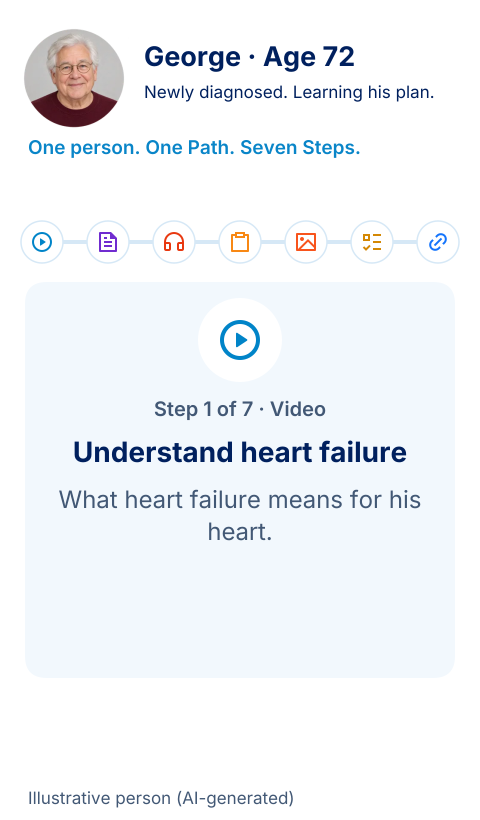
Follow George through an illustrative seven-Step Path as he starts care for a new heart failure diagnosis made during a hospital stay. A hospital could use this structure to organize the education its heart failure team repeats with every newly diagnosed patient, from what heart failure means to his first follow-up visit.
Illustrative person (AI-generated). Illustrative educational Path. Completion does not establish a clinical outcome.
What his new heart failure diagnosis means: his heart is not pumping as well as his body needs, and his care team has a plan to help him manage it.
His type of heart failure and his ejection fraction, a measure of how well his heart pumps, as his cardiology team explains them to him.
Why his team prescribed each heart failure medicine, how to take each one as prescribed, and why not to stop or change one without his team.
George sets up a personal log for his morning weight and the symptoms his team asks him to watch, to bring to his visits. It is not sent to or monitored by his team.
A picture guide to spotting hidden salt in everyday foods, with the salt and fluid limits his team sets for him.
Practice which changes to report to his team, like sudden weight gain, more swelling or new shortness of breath, and which signs, like chest pain or feeling faint, mean calling 911.
His first follow-up visit, which his team schedules for soon after he goes home, any tests his team ordered and how to reach his team between visits.
Assign a value to the Understanding My Heart Failure Diagnosis Path and see the results.
How many times your team already does this workflow each year.
65.5staff hours saved per year
$2,291estimated value per year
Change the assumptions above to see your estimate of time and money saved.
CREATE
Cardiology nurses turn the heart failure education they repeat with every patient into a structured Path and assign it a value of 21 minutes of staff education time saved per patient.
ENGAGE
Each year, 187 patients like George learn about heart failure after a hospital stay with the Understanding My Heart Failure Diagnosis Path, saving 21 minutes of education time each.
KNOW
That adds up to 3,927 minutes (65.5 hours) of staff time, worth an estimated $2,291 a year at $35.00 an hour.
IMPROVE
Engagement, knowledge checks and questions show where heart failure education was clear or confusing, so the care team can refine it for the next patient.
Every Heart Failure Journey Creates an Opportunity to Improve the Next.
Estimates are illustrative and use the assumptions above. They are not measured results.
What begins with a heart failure diagnosis leads to more than one Path. From understanding his diagnosis to his medicines, going home, daily weights, food and fluid choices, a later episode of worsening symptoms, cardiac rehabilitation and his follow-up visit, George needs guidance at every stage. PATHS connects multiple Paths into an experience tailored to his changing needs, and each Path could save the care team time, not only the first. This journey is illustrative.
George's care doesn't stop at one Path. After his hospital stay, the health system could provide a Path for each part of his recovery: understanding his diagnosis, his discharge plan, daily weights and medicines, food and fluid choices, recognizing worsening symptoms, and his follow-up visit. Each Path George completes also shows his care team what he engaged with, what he understood and what he still had questions about.
George can revisit his team's guidance on daily weights and medicines whenever he needs it. The steps patients revisit most show where the teaching can be clearer.
George knows which changes to report and when emergency help is needed. The answers patients get wrong show which instructions need work.
George arrives at his follow-up prepared, with his questions ready. That helps the team focus the visit on his recovery.
The more the health system knows about each patient's experience and journey, the better it can make its workflows. What George and every other patient engage with, understand and ask about becomes health system intelligence: the team learns from every patient and refines each Path, so the next patient's experience is better. Clearer Paths mean fewer repeat calls and less time re-teaching the same education, and that saves time and money across the health system.
Medical Specialties

Neurosciences

Neurosciences

Cancer

Neurosciences

Surgery
1–6 of 25
Improving heart failure care doesn't require changing every workflow at once.
Start with a patient journey that matters to your organization. Build a structured approach, understand how patients and caregivers engage, and use what you learn to improve the experience.