



Cardiovascular

Type 2 diabetes asks patients to make daily decisions about medications, glucose checks, meals and activity, often with a clinic visit only every 3 to 6 months.
PATHS helps healthcare organizations turn clinical expertise into actionable patient journeys, giving patients and caregivers clear guidance while providing care teams with visibility into engagement, understanding, and progress.
Type 2 diabetes asks patients to make daily decisions about medications, glucose checks, meals and activity, often with a clinic visit only every 3 to 6 months. The questions and problems that come up in between reach the care team as phone calls and portal messages.3
40.1M1
Americans living with diabetes; type 2 is 90 to 95% of cases
53%1
Adults with diagnosed diabetes whose A1C is 7% or higher
$412.9B4
Estimated U.S. cost of diagnosed diabetes in 2022
About 40.1 million Americans have diabetes, and type 2 accounts for 90 to 95% of cases. Managing it takes daily decisions about medications, glucose checks, meals and activity. In CDC's latest report, 53.2% of adults with diagnosed diabetes have an A1C of 7% or higher, and only 14.9% meet all of their A1C, blood pressure, cholesterol and nonsmoking goals.1,2
Much of diabetes care now happens outside scheduled visits. In two U.S. health systems, phone calls and portal messages made up more than half of all care-team encounters for patients with diabetes, and that work was rarely billed. Nationally, diabetes accounts for an estimated 120 million office visits a year.3,4
In 2021, U.S. adults had about 16.5 million ED visits and 8.1 million hospital stays where diabetes was a listed diagnosis. Diagnosed diabetes cost an estimated $412.9 billion in 2022, and hospital inpatient care was the largest single share of the $306.6 billion in medical costs. Diabetes is not in Medicare's readmissions penalty program, but an A1C above 9% counts against Medicare ACOs as a quality measure.1,4,5,9
Diabetes self-management education and support lowers A1C by about 0.45 to 0.57 points and improves quality of life, according to a consensus report led by the American Diabetes Association. In an observational CMS study, newly diagnosed Medicare patients who used this training had 14% lower odds of any hospitalization and about $830 lower Medicare spending the next year, yet only about 5% used it (2010 data), even though Medicare covers up to 10 hours of training in the first year. These findings concern diabetes education and training programs, not PATHS. A Path could organize the educational materials and next steps selected by the diabetes care team.2,6,7,8
Healthcare teams have a critical responsibility to educate and prepare patients for that journey. But once patients leave the clinical setting, how do we know they're ready?
Do they understand their care plan? Can they apply what they've learned? Are they following through? Where do they need additional support?
Preparing patients for the journey is essential. Knowing how they're managing it creates the opportunity to improve care.
Education and knowledge
Explain type 2 diabetes and the education selected by the person's clinical team.
Tasks, decisions, follow-through
Help patients prepare goals and questions for discussions about their daily care plan.
Medications, appointments, self-care
Keep the team's guidance on medicines, glucose checks, meals, activity and appointments easy to revisit.
Assessments and engagement evidence
Use assessments to check understanding and identify where patients need further education.
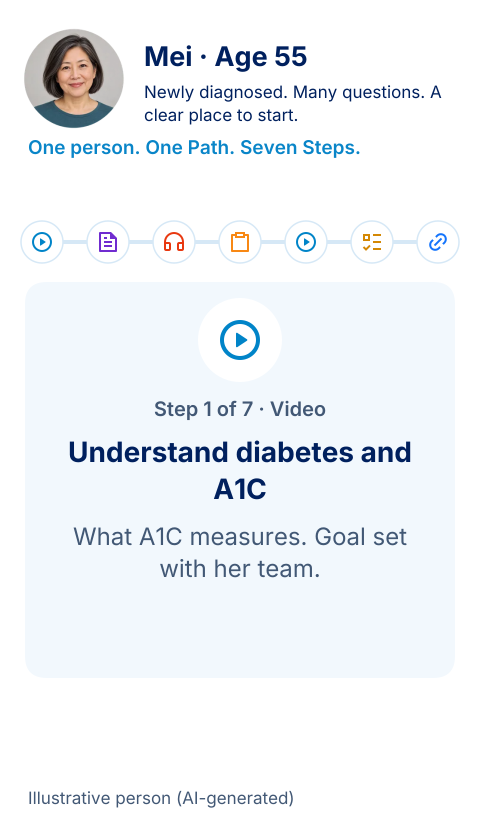
Follow Mei through an illustrative seven-Step Path. A hospital could use this structure to organize education selected by its diabetes care team, help patients prepare questions and connect them with diabetes education and follow-up.
Understanding My Diabetes Diagnosis Path
Illustrative person (AI-generated). Illustrative educational Path. Completion does not establish a clinical outcome.
What A1C measures, and why Mei’s goal is set with her care team.
A printable guide to her team’s medicines, any glucose monitoring and contact instructions.
Short guidance on food and movement that fits her preferences and daily life.
Mei notes cost, access, routine or stress concerns to discuss with her team.
Review the team’s medicine instructions, warning signs and when to seek help.
Practice recognizing when to contact her team and revisit anything unclear.
Find how to join diabetes education and review her team’s follow-up instructions.
Assign a value to the Understanding My Diabetes Diagnosis Path and see the results.
How many times your team already does this workflow each year.
65.5staff hours saved per year
$2,291estimated value per year
Change the assumptions above to see your estimate of time and money saved.
CREATE
Diabetes educators turn the teaching they repeat with every newly diagnosed patient into a structured Path and assign it a value of 21 minutes of staff education time saved per patient.
ENGAGE
Each year, 187 patients like Mei learn about a new type 2 diabetes diagnosis with the Understanding My Diabetes Diagnosis Path, saving 21 minutes of education time each.
KNOW
That adds up to 3,927 minutes (65.5 hours) of staff time, worth an estimated $2,291 a year at $35.00 an hour.
IMPROVE
Engagement, knowledge checks and questions show where diabetes education was clear or confusing, so the care team can refine it for the next patient.
Every Type 2 Diabetes Journey Creates an Opportunity to Improve the Next.
Estimates are illustrative and use the assumptions above. They are not measured results.
Mei's care doesn't stop at one Path. As she starts her plan, the health system could provide a Path for each part of her care: understanding her diagnosis and A1C, her daily care plan, food and movement, her medicines, and diabetes education classes. Each Path Mei completes also shows her care team what she engaged with, what she understood and what she still had questions about.
Mei can revisit guidance on food and movement that fits her life whenever she needs it. The topics patients revisit most show where the guidance can be clearer.
Mei reviews her medicine instructions and warning signs. Knowledge checks show the team which instructions need clearer teaching.
Mei finds how to join diabetes education classes. Knowing where patients get stuck helps the team connect more of them to education.
The more the health system knows about each patient's experience and journey, the better it can make its workflows. What Mei and every other patient engage with, understand and ask about becomes health system intelligence: the team learns from every patient and refines each Path, so the next patient's experience is better. Clearer Paths mean fewer repeat calls and less time re-teaching the same education, and that saves time and money across the health system.
Cardiovascular

Neurosciences

Neurosciences

Cancer

Neurosciences

Surgery
1–6 of 25
Improving type 2 diabetes care doesn't require changing every workflow at once.
Start with a patient journey that matters to your organization. Build a structured approach, understand how patients and caregivers engage, and use what you learn to improve the experience.