




Medical Specialties

Between treatments, patients manage side effects such as nausea, fever, pain and dehydration at home, often with a delayed onset, while keeping up with appointments, tests and referrals.
PATHS helps healthcare organizations turn clinical expertise into actionable patient journeys, giving patients and caregivers clear guidance while providing care teams with visibility into engagement, understanding, and progress.
Between treatments, patients manage side effects such as nausea, fever, pain and dehydration at home, often with a delayed onset, while keeping up with appointments, tests and referrals. Once treatment ends, survivors still face follow-up care and lasting physical, emotional and financial effects.2,3
2.1M1
New cancer cases projected in the U.S. in 2026
18.6M2
Americans living with a history of cancer
10.7 per 1007
Medicare outpatient chemotherapy patients admitted within 30 days for a potentially preventable condition (2024)
That burden reaches the care team as calls, portal messages and alerts. Across 15,653 U.S. oncologists, inbox messages rose 19% from 2019 to 2022 and patient messages rose 34%, with medical oncologists averaging about 200 messages a week. In a 52-practice trial of between-visit symptom monitoring, nearly half of nurses said there were too many alerts and asked for dedicated nursing time to respond.4,5
In a national sample, cancer patients made 4.2% of adult ED visits, and 59.7% of those visits ended in admission, compared with 16.3% for other patients. CMS publicly reports each hospital's rate of ED visits and admissions within 30 days of outpatient chemotherapy for ten potentially preventable conditions, including nausea, dehydration, pain and fever (measure OP-35). In 2024 the national rates were 10.7 admitted and 5.4 seen in the ED per 100 Medicare chemotherapy patients.3,6,7
In a randomized trial, patients who reported symptoms between visits had better quality of life, fewer ER visits (34% vs 41%) and stayed on chemotherapy longer. Across 52 community practices, weekly symptom check-ins improved physical function and symptom control, reduced ED visits, and 89% of patients would recommend them. In an observational study of older Medicare patients, costs with lay navigation fell $781 more per patient per quarter than in a matched comparison group, with faster declines in ED visits, admissions and ICU stays. These studies evaluated staffed symptom-monitoring and navigation programs, not PATHS. A Path could organize patient education and the next steps selected by the oncology team.5,8,9
Healthcare teams have a critical responsibility to educate and prepare patients for that journey. But once patients leave the clinical setting, how do we know they're ready?
Do they understand their care plan? Can they apply what they've learned? Are they following through? Where do they need additional support?
Preparing patients for the journey is essential. Knowing how they're managing it creates the opportunity to improve care.
Education and knowledge
Help patients and caregivers understand the treatment information their oncology team provides.
Tasks, decisions, follow-through
Prepare patients to ask questions and follow their team's instructions for contacting support.
Medications, appointments, self-care
Connect guidance about visits, treatment preparation and recovery in one journey.
Assessments and engagement evidence
Show the team where patients engage with guidance and where more explanation may be needed.
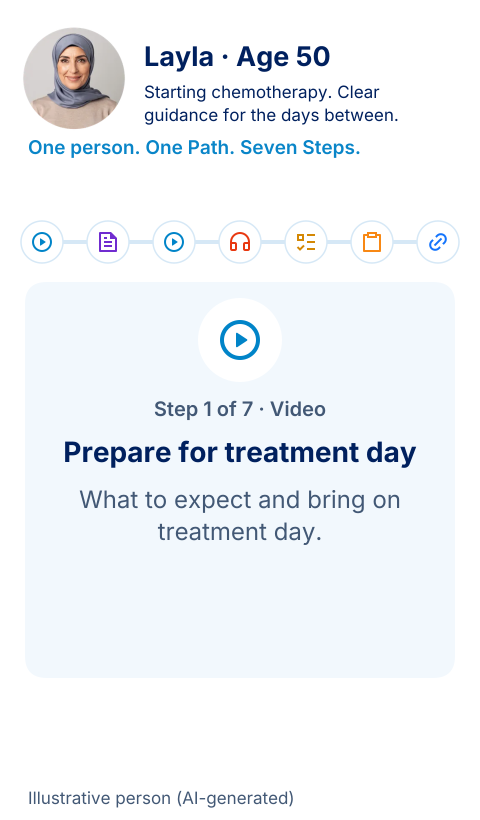
Follow Layla through an illustrative seven-Step Path. A hospital could use this structure to organize education selected by its oncology care team, help patients know when to call and connect them with navigation and support services.
Illustrative person (AI-generated). Illustrative educational Path. Completion does not establish a clinical outcome.
What to expect at the infusion center, how long a visit may take and what to bring.
Her team’s schedule of treatments, lab tests and visits, with daytime and after-hours phone numbers.
Why a fever during chemotherapy is an emergency, and the other symptoms her team wants reported right away.
Her team’s guidance on nausea, eating, fluids and rest between treatments.
Practice telling which symptoms need a call right away and which can wait for her next visit.
Layla notes symptoms, questions and practical needs, like rides, work or costs, to discuss at each visit.
Find the navigation, social work and support services her cancer center offers.
Assign a value to the Starting Chemotherapy Path and see the results.
How many times your team already does this workflow each year.
65.5staff hours saved per year
$2,291estimated value per year
Change the assumptions above to see your estimate of time and money saved.
CREATE
Oncology nurses turn the chemotherapy teaching they repeat before every first infusion into a structured Path and assign it a value of 21 minutes of staff education time saved per patient.
ENGAGE
Each year, 187 patients like Layla start chemotherapy with the Starting Chemotherapy Path, saving 21 minutes of education time each.
KNOW
That adds up to 3,927 minutes (65.5 hours) of staff time, worth an estimated $2,291 a year at $35.00 an hour.
IMPROVE
Engagement, knowledge checks and questions show where the chemotherapy guidance was clear or confusing, so the care team can refine it for the next patient.
Every Cancer Care Journey Creates an Opportunity to Improve the Next.
Estimates are illustrative and use the assumptions above. They are not measured results.
What begins with a first chemotherapy appointment leads to more than one Path. From starting chemotherapy to understanding her cancer, managing side effects, a fever between treatments, her seven-week wellness check, her disability application, changes in appetite and her survivorship care plan, Layla needs guidance at every stage. PATHS connects multiple Paths into an experience tailored to her changing needs, and each Path could save the care team time, not only the first. This journey is illustrative.
Layla's care doesn't stop at one Path. From her first infusion through the rest of treatment, the health system provides a Path for each stage: starting chemotherapy, understanding her cancer, managing side effects, wellness check-ins, and social work support. Each Path Layla completes also shows her care team what she engaged with, what she understood and what she still had questions about.
Layla can revisit what her team explained about her diagnosis and treatment whenever she needs it. The questions patients ask show the team which parts of the education need work.
Layla checks in with her team during treatment. Her answers help the team see when she may need more support.
Layla gets help with the paperwork that keeps her family's finances steady. The barriers patients report show the team where social work support is needed.
The more the health system knows about each patient's experience and journey, the better it can make its workflows. What Layla and every other patient engage with, understand and ask about becomes health system intelligence: the team learns from every patient and refines each Path, so the next patient's experience is better. Clearer Paths mean fewer repeat calls and less time re-teaching the same education, and that saves time and money across the health system.
Medical Specialties

Cardiovascular
Neurosciences
Neurosciences

Neurosciences

Surgery
1–6 of 25
Improving cancer care doesn't require changing every workflow at once.
Start with a patient journey that matters to your organization. Build a structured approach, understand how patients and caregivers engage, and use what you learn to improve the experience.