



Medical Specialties

Different autoimmune conditions can require very different care plans.
PATHS helps healthcare organizations turn clinical expertise into actionable patient journeys, giving patients and caregivers clear guidance while providing care teams with visibility into engagement, understanding, and progress.
Different autoimmune conditions can require very different care plans. Patients need to understand their own diagnosis, recognize changes and know which questions to bring to the team.
15M+1
People estimated to have a diagnosed autoimmune disease in a U.S. EHR study
4.6%1
Estimated U.S. population prevalence in that study
34%1
Of people with autoimmune disease in the study had more than one diagnosis
A study of six U.S. medical systems estimated that more than 15 million people had a diagnosed autoimmune disease, using records from 2011–2022. About 34% had more than one autoimmune diagnosis, adding complexity to the care journey.1
Inflammatory arthritis guidance calls for ongoing education, shared decisions and self-management support. A supporting review notes time pressure, service availability and uncertainty about available resources as obstacles for healthcare professionals. These needs extend beyond a single consultation.2,3
Inflammatory arthritis can affect pain, fatigue, physical function and emotional well-being. Helping someone manage those effects requires attention to daily life alongside clinical treatment. Autoimmune conditions differ, so no single complication rate describes them all.3
The EULAR evidence review found benefits from selected self-management approaches, including education, problem solving and goal setting, for some inflammatory arthritis outcomes such as self-efficacy. Results varied across interventions. This supports tailored support, without claiming that education controls every autoimmune disease or reduces hospital costs.3
Healthcare teams have a critical responsibility to educate and prepare patients for that journey. But once patients leave the clinical setting, how do we know they're ready?
Do they understand their care plan? Can they apply what they've learned? Are they following through? Where do they need additional support?
Preparing patients for the journey is essential. Knowing how they're managing it creates the opportunity to improve care.
Education and knowledge
Explain the person's condition and the treatment information selected by their clinical team.
Tasks, decisions, follow-through
Help patients prepare questions about symptoms, treatment and daily life for their next visit.
Medications, appointments, self-care
Organize education about the agreed care plan and preparation for follow-up appointments.
Assessments and engagement evidence
Use assessments to identify questions or gaps in understanding for the team to review.
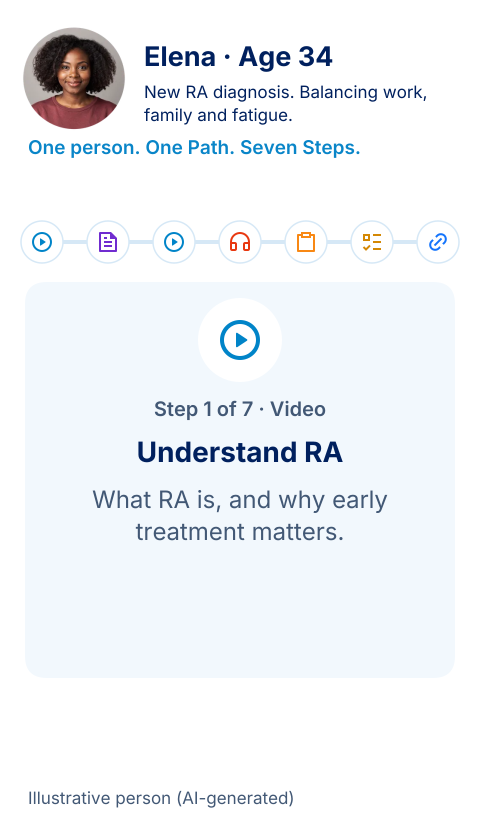
Follow Elena through an illustrative seven-Step Path. A hospital could use this structure to share education its rheumatology team selects, support self-management and make infection warning signs easy to recognize.
Understanding My Rheumatology Diagnosis Path
Illustrative person (AI-generated). Illustrative educational Path. Completion does not establish a clinical outcome.
What rheumatoid arthritis is, why early treatment matters, and how her rheumatology team adjusts care over time.
Her team’s instructions for her medicines, vaccines and follow-up visits, in one place.
Some RA treatments lower the body’s defenses, so fever, chills or other signs of infection mean calling her team.
Regular physical activity that fits her day, as her team recommends.
Elena notes joint symptoms, morning stiffness, fatigue and questions to discuss at her next visit.
Practice which changes to note for her next visit and which mean calling her team, such as fever, chills, sore throat or cough while on treatment.
Resources on working and parenting with RA, and support programs her rheumatology team suggests.
Assign a value to the Understanding My Rheumatology Diagnosis Path and see the results.
How many times your team already does this workflow each year.
65.5staff hours saved per year
$2,291estimated value per year
Change the assumptions above to see your estimate of time and money saved.
CREATE
Rheumatology clinicians turn the diagnosis education they repeat with every new patient into a structured Path and assign it a value of 21 minutes of staff education time saved per patient.
ENGAGE
Each year, 187 patients like Elena learn about a new rheumatoid arthritis diagnosis with the Understanding My Rheumatology Diagnosis Path, saving 21 minutes of education time each.
KNOW
That adds up to 3,927 minutes (65.5 hours) of staff time, worth an estimated $2,291 a year at $35.00 an hour.
IMPROVE
Engagement, knowledge checks and questions show where diagnosis education was clear or confusing, so the care team can refine it for the next patient.
Every Autoimmune Disorders Journey Creates an Opportunity to Improve the Next.
Estimates are illustrative and use the assumptions above. They are not measured results.
Elena's care doesn't stop at one Path. After her diagnosis, the rheumatology team provides a Path for each part of her first months: understanding her diagnosis, treatment questions, living with fatigue, joint care, and support at work and home. Each Path Elena completes also shows her care team what she engaged with, what she understood and what she still had questions about.
Elena prepares to discuss her treatment and monitoring plan. The questions patients bring show the team which parts of treatment education need work.
Elena returns to her team's fatigue resources whenever she needs them. The resources patients revisit most show the team where support matters.
Elena arrives at her review ready to discuss how her plan is working. That helps the team focus the visit on what matters to her.
The more the health system knows about each patient's experience and journey, the better it can make its workflows. What Elena and every other patient engage with, understand and ask about becomes health system intelligence: the team learns from every patient and refines each Path, so the next patient's experience is better. Clearer Paths mean fewer repeat calls and less time re-teaching the same education, and that saves time and money across the health system.
Medical Specialties

Cardiovascular

Neurosciences

Neurosciences

Cancer

Neurosciences
1–6 of 25
Improving autoimmune care doesn't require changing every workflow at once.
Start with a patient journey that matters to your organization. Build a structured approach, understand how patients and caregivers engage, and use what you learn to improve the experience.