




Medical Specialties

For people with heart disease or high blood pressure, the real work happens at home: taking daily medicines, checking blood pressure, eating and moving differently, and finishing cardiac rehab after a heart attack or procedure.
PATHS helps healthcare organizations turn clinical expertise into actionable patient journeys, giving patients and caregivers clear guidance while providing care teams with visibility into engagement, understanding, and progress.
For people with heart disease or high blood pressure, the real work happens at home: taking daily medicines, checking blood pressure, eating and moving differently, and finishing cardiac rehab after a heart attack or procedure. Not everyone keeps up: more than 1 in 4 older adults on blood pressure medicine through Medicare Part D do not take it as prescribed.3,9,11
127.9M1
U.S. adults with some form of cardiovascular disease, counting high blood pressure
1 in 42
U.S. adults with high blood pressure who have it under control
$233B1
Yearly U.S. direct medical costs of cardiovascular disease
About 127.9 million U.S. adults, nearly half, have some form of cardiovascular disease once high blood pressure is counted. Only about 1 in 4 adults with high blood pressure has it under control. More than 1 in 4 older adults on blood pressure medicine through Medicare Part D do not take it as prescribed.1,2,3
High blood pressure alone is tied to about 168 million outpatient visits and 538 million prescription fills in a single year. One national model found a primary care clinician would need about 7.2 hours a day just to deliver guideline-recommended chronic disease care to a typical panel. Medicare covers chronic care management for eligible patients with two or more chronic conditions. Some codes require at least 20 minutes of clinical staff time per month, along with care-plan, consent and other service requirements.4,5,6
Cardiovascular disease costs the U.S. about $418 billion a year including lost productivity, and its direct medical costs make up 11% of all U.S. health spending. High blood pressure alone is tied to about 6 million ED visits, 3.5 million hospital stays and $79 billion in inpatient spending a year. Heart attack and bypass surgery are both in Medicare's Hospital Readmissions Reduction Program, which can cut a hospital's Medicare fee-for-service base operating inpatient payments by up to 3%. Among veterans with heart and vessel disease, those who filled less than half of their statins had a 30% higher risk of death than those who filled 90% or more, an association rather than proof of cause.1,4,7,8
Across 100 studies (121 comparisons), team-based care in which a non-physician team member, such as a nurse or pharmacist, adjusted medicines lowered systolic blood pressure by about 7 mm Hg, more than any other strategy tested. Each 10 mm Hg drop in systolic pressure lowers the risk of major cardiovascular events by about 20%. Exercise-based cardiac rehab cut hospital admissions by 42% and heart attacks by 28% over 6 to 12 months. These results came from treatment and rehabilitation programs, not PATHS. A Path could organize the team's education and agreed next steps alongside those clinical services.9,10,11
Healthcare teams have a critical responsibility to educate and prepare patients for that journey. But once patients leave the clinical setting, how do we know they're ready?
Do they understand their care plan? Can they apply what they've learned? Are they following through? Where do they need additional support?
Preparing patients for the journey is essential. Knowing how they're managing it creates the opportunity to improve care.
Education and knowledge
Explain heart health, risk factors and the care plan selected by the clinical team.
Tasks, decisions, follow-through
Help patients work through agreed education and prepare for rehabilitation or follow-up.
Medications, appointments, self-care
Keep the team's guidance on medicines, appointments and daily routines easy to revisit.
Assessments and engagement evidence
Use assessments to check understanding of the plan and identify questions for the care team.
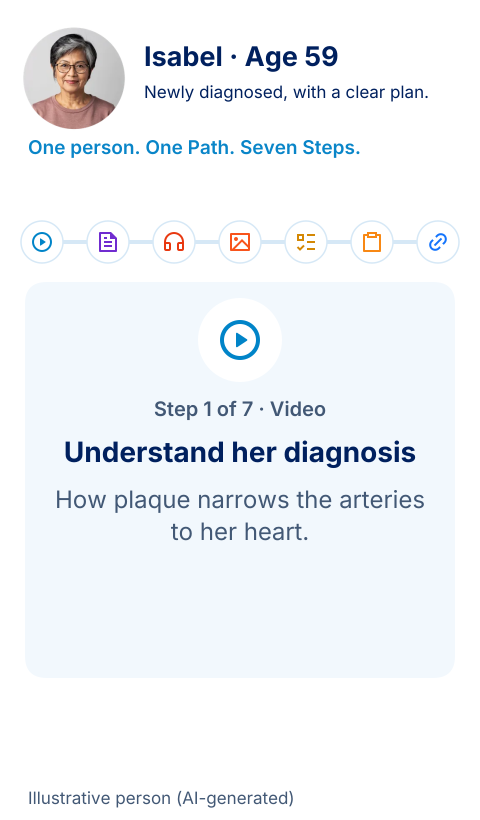
Follow Isabel through an illustrative seven-Step Path as she starts care for a new cardiovascular disease diagnosis. A hospital could use this structure to organize the education its cardiology team repeats with every newly diagnosed patient, from what the diagnosis means to her follow-up plan.
Illustrative person (AI-generated). Illustrative educational Path. Completion does not establish a clinical outcome.
What her cardiovascular disease diagnosis means: plaque has narrowed the arteries that supply her heart (coronary artery disease), as her cardiology team explains.
Her risk factors and the numbers her team tracks, such as blood pressure, cholesterol and blood sugar, with the goals her team sets for her.
Why her team prescribed each new medicine, how to take it as prescribed, and why not to stop or change one without her team.
A picture guide to eating well, moving more, sleeping well and not smoking, with activities like gardening at the pace her team advises.
Practice which changes to report to her team, like angina that comes more often, and which heart attack or stroke warning signs mean calling 911.
Isabel writes down questions for her next visit, such as how her diagnosis affects gardening and time with her grandchildren.
Her cardiac care plan: her next visit, any tests her team ordered and how to reach her team between visits.
Assign a value to the Understanding My Cardiovascular Disease Diagnosis Path and see the results.
How many times your team already does this workflow each year.
65.5staff hours saved per year
$2,291estimated value per year
Change the assumptions above to see your estimate of time and money saved.
CREATE
Cardiology clinicians turn the education they repeat with every newly diagnosed patient into a structured Path and assign it a value of 21 minutes of staff education time saved per patient.
ENGAGE
Each year, 187 patients like Isabel learn about a new cardiovascular disease diagnosis with the Understanding My Cardiovascular Disease Diagnosis Path, saving 21 minutes of education time each.
KNOW
That adds up to 3,927 minutes (65.5 hours) of staff time, worth an estimated $2,291 a year at $35.00 an hour.
IMPROVE
Engagement, knowledge checks and questions show where diagnosis education was clear or confusing, so the care team can refine it for the next patient.
Every Cardiovascular Disease Journey Creates an Opportunity to Improve the Next.
Estimates are illustrative and use the assumptions above. They are not measured results.
What begins with a cardiovascular disease diagnosis leads to more than one Path. From understanding her diagnosis to her medicines, her home routine, a heart attack treated with a stent, cardiac rehabilitation and her follow-up visit, Isabel needs guidance at every stage. PATHS connects multiple Paths into an experience tailored to her changing needs, and each Path could save the care team time, not only the first. This journey is illustrative.
Isabel's care doesn't stop at one Path. As she starts her plan, the health system provides a Path for each part of it: understanding her diagnosis, her risk factors, her treatment, her home routine, and cardiac rehabilitation. Each Path Isabel completes also shows her care team what she engaged with, what she understood and what she still had questions about.
Isabel organizes the daily actions she agreed with her clinicians, around caring for her family. The steps patients find hardest show the team where to offer more support.
Isabel can revisit her team's monitoring guidance whenever she needs it. The questions patients ask show which instructions need work.
Isabel arrives at her next visit ready to discuss how the plan fits her life. That helps the team focus the visit on what matters to her.
The more the health system knows about each patient's experience and journey, the better it can make its workflows. What Isabel and every other patient engage with, understand and ask about becomes health system intelligence: the team learns from every patient and refines each Path, so the next patient's experience is better. Clearer Paths mean fewer repeat calls and less time re-teaching the same education, and that saves time and money across the health system.
Medical Specialties

Cardiovascular

Neurosciences

Neurosciences

Cancer

Neurosciences
1–6 of 25
Improving cardiovascular care doesn't require changing every workflow at once.
Start with a patient journey that matters to your organization. Build a structured approach, understand how patients and caregivers engage, and use what you learn to improve the experience.