



Medical Specialties

A child's care plan often depends on several adults, while adolescents gradually take on more responsibility.
PATHS helps healthcare organizations turn clinical expertise into actionable patient journeys, giving patients and caregivers clear guidance while providing care teams with visibility into engagement, understanding, and progress.
A child's care plan often depends on several adults, while adolescents gradually take on more responsibility. Useful guidance needs to reach the people helping at each stage.
4.7M1
U.S. children with current asthma in CDC's 2021 survey estimates
38.7%1
Children with asthma who had an attack in the previous year, 2021
Asthma is one example of a pediatric journey that crosses settings. CDC estimated that 4.7 million U.S. children had current asthma in 2021, and 38.7% of those children had an attack in the preceding year.1
CDC describes effective school asthma programs as a partnership among healthcare providers, school nurses, staff, parents and children. Teams coordinate medicines, education and follow-up across settings, with support adapted to the child's needs.2
An asthma plan has to be usable where symptoms happen, including school. Staff need appropriate preparation and links to healthcare providers. This example illustrates the coordination challenge without assuming that asthma findings describe every pediatric condition.2
A Cochrane review of school-based asthma self-management found probable reductions in hospital admissions and small improvements in asthma-related quality of life. Emergency visits may decrease, but school-absence effects were uncertain. Most effectiveness studies involved younger children; results cannot be extended to all adolescent care.3
Healthcare teams have a critical responsibility to educate and prepare patients for that journey. But once patients leave the clinical setting, how do we know they're ready?
Do they understand their care plan? Can they apply what they've learned? Are they following through? Where do they need additional support?
Preparing patients for the journey is essential. Knowing how they're managing it creates the opportunity to improve care.
Education and knowledge
Help children, adolescents and caregivers understand age-appropriate guidance from their care team.
Tasks, decisions, follow-through
Prepare families to ask questions and follow the next steps agreed with the clinician.
Medications, appointments, self-care
Keep education about daily routines, appointments and transitions in care easy to revisit.
Assessments and engagement evidence
Check what families understand and identify questions for the clinical team to address.
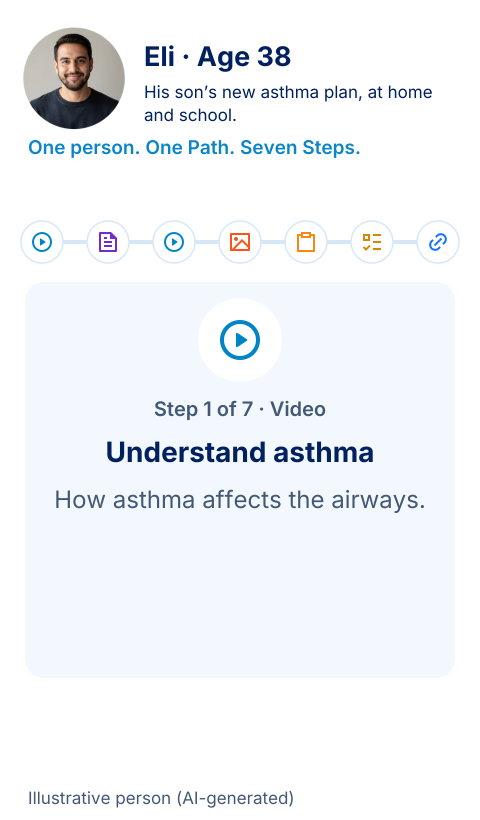
Follow Eli, whose son Jonah has asthma, through an illustrative seven-Step Path. A hospital could use this structure to share caregiver education its pediatric team selects, get the action plan to school and make danger signs easy to recognize.
Understanding My Asthma Diagnosis Path
Illustrative person (AI-generated). Illustrative educational Path. Completion does not establish a clinical outcome.
What happens in the airways during asthma, and how Jonah’s care team keeps it under control.
Jonah’s written asthma action plan from his care team: daily medicines, signs of worsening and what to do.
The difference between his daily controller and his quick-relief inhaler, and the technique his team showed them.
A room-by-room picture of common triggers, such as smoke, dust mites, pets, mold and pests.
Eli completes the school asthma forms so the school nurse has Jonah’s action plan and medicine instructions.
Practice which signs mean following the action plan and calling the doctor, and which mean calling 911, such as trouble walking or talking, hunching over, blue or gray lips or nails, or confusion.
Jonah’s follow-up visit details and questions to bring about symptoms, activities and school.
Assign a value to the Understanding My Asthma Diagnosis Path and see the results.
How many times your team already does this workflow each year.
65.5staff hours saved per year
$2,291estimated value per year
Change the assumptions above to see your estimate of time and money saved.
CREATE
Pediatric clinicians turn the asthma education they repeat with every family into a structured Path and assign it a value of 21 minutes of staff education time saved per patient.
ENGAGE
Each year, 187 children like Eli learn about their asthma diagnosis with the Understanding My Asthma Diagnosis Path, saving 21 minutes of education time each.
KNOW
That adds up to 3,927 minutes (65.5 hours) of staff time, worth an estimated $2,291 a year at $35.00 an hour.
IMPROVE
Engagement, knowledge checks and questions show where asthma education was clear or confusing, so the care team can refine it for the next patient.
Every Pediatric & Adolescent Care Journey Creates an Opportunity to Improve the Next.
Estimates are illustrative and use the assumptions above. They are not measured results.
Jonah's care doesn't stop at one Path. As Eli helps his son manage asthma, the pediatric practice provides a Path for each part of it: understanding asthma, his inhaler, his school plan, activities, and recognizing changes. Each Path Eli and Jonah complete also shows the care team what they engaged with, what they understood and what they still had questions about.
Eli coordinates Jonah's asthma plan with the school. The questions families raise show the team where the plan needs clearer guidance.
Jonah learns when to ask an adult for help. Knowledge checks show the team which warning signs need clearer teaching.
Eli and Jonah agree which tasks Jonah feels ready to manage. That helps the team support each step toward independence.
The more the health system knows about each patient's experience and journey, the better it can make its workflows. What Eli's family and every other family engage with, understand and ask about becomes health system intelligence: the team learns from every patient and refines each Path, so the next patient's experience is better. Clearer Paths mean fewer repeat calls and less time re-teaching the same education, and that saves time and money across the health system.
Medical Specialties

Cardiovascular

Neurosciences

Neurosciences

Cancer

Neurosciences
1–6 of 25
Improving pediatric and adolescent care doesn't require changing every workflow at once.
Start with a patient journey that matters to your organization. Build a structured approach, understand how patients and caregivers engage, and use what you learn to improve the experience.