




Medical Specialties

Prevention education has to reach students, parents and teachers, and the people teaching it need to know it landed.
PATHS helps schools, health systems and community partners turn prevention expertise into actionable journeys, giving young people and families clear guidance while providing educators and care teams with visibility into engagement, understanding, and progress.
Counterfeit pills can look exactly like real prescriptions. Students, parents and teachers need clear, accurate guidance, and the people teaching it need to know what students understood.
84%1
U.S. adolescent (ages 10–19) overdose deaths involving illicitly manufactured fentanyl, July 2019–December 2021
~25%1
Adolescent overdose deaths where counterfeit pills were present
From late 2019 to late 2021, median monthly overdose deaths among U.S. adolescents rose 109%, and deaths involving illicitly manufactured fentanyl rose 182%. About 84% of these deaths involved illicitly manufactured fentanyl.1
DEA laboratory testing found that 7 of every 10 fentanyl pills it seized contained a potentially lethal dose. As little as 2 mg of fentanyl can be lethal.2
In two-thirds of these deaths, one or more potential bystanders were present, but most provided no overdose response. Naloxone administration was documented in about 30% of deaths.1
CDC recommends educating adolescents about the dangers of illicitly manufactured fentanyl and counterfeit pills, issuing warnings to schools and parents, and expanding naloxone access and training for family and friends.1
Schools and care teams have a critical responsibility to prepare young people for these risks. But once the lesson ends, how do we know students are ready?
Do they understand the risks? Can they apply what they've learned? Do they know how to respond? Where do they need additional support?
Teaching prevention is essential. Knowing what students understood creates the opportunity to improve it.
Education and knowledge
Help students, parents and teachers understand fentanyl, counterfeit pills and other substance risks.
Tasks, decisions, follow-through
Prepare young people to make safer choices, such as committing to the No Random Pills pledge.
Recognition and response
Keep guidance on recognizing an overdose and using naloxone easy to revisit.
Assessments and engagement evidence
Use knowledge checks before and after the Path to see what students understood and where to reteach.
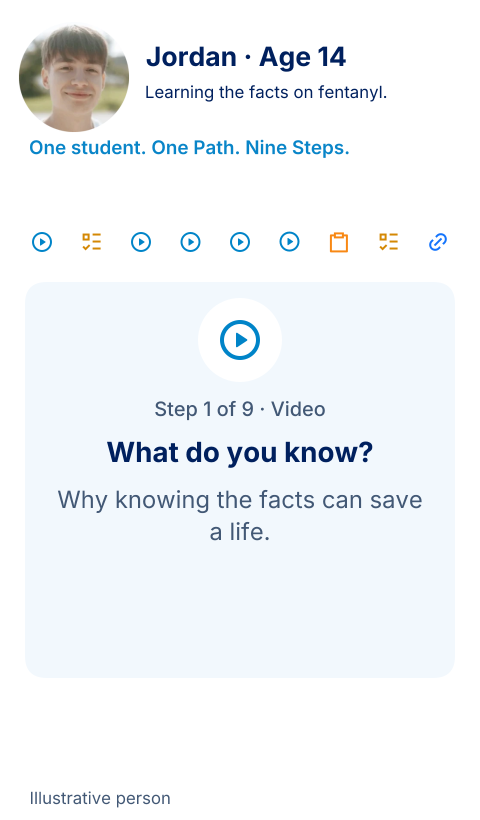
Follow Jordan, a 14-year-old high school freshman, through nine Steps of a Path from Arizona's STOP-IT Initiative. A school or health system could use this structure to check what students know, teach the real risks, show how to respond to an overdose and measure what students learned.
What Arizona High School Students Need to Know About Fentanyl Path
Illustrative person. Illustrative educational Path. Completion does not establish a clinical outcome. Path content from Arizona's STOP-IT Initiative.
The Path opens by asking what students already know, and why knowing the facts about fentanyl can save a life.
The AZ Pre-Knowledge Check: 10 questions on fentanyl facts and overdoses, before the lessons begin.
Understanding fentanyl risks in Arizona schools.
A teen's story of fentanyl addiction.
What Arizona law says about opioids.
How to reverse an opioid overdose and respond if a friend overdoses.
Jordan commits to the No Random Pills Pledge.
The AZ Knowledge Check repeats the fentanyl and overdose quiz after the lessons, so the school can see what changed.
Extra resources for students and families.
Assign a value to the What Arizona High School Students Need to Know About Fentanyl Path and see the results.
How many times your team already does this workflow each year.
122.7staff hours saved per year
$4,296estimated value per year
Change the assumptions above to see your estimate of time and money saved.
CREATE
Prevention educators turn the fentanyl education they repeat with every class into a structured Path and assign it a value of 28 minutes of staff education time saved per patient.
ENGAGE
Each year, 263 students like Jordan learn about fentanyl and counterfeit pills with the What Arizona High School Students Need to Know About Fentanyl Path, saving 28 minutes of education time each.
KNOW
That adds up to 7,364 minutes (122.7 hours) of staff time, worth an estimated $4,296 a year at $35.00 an hour.
IMPROVE
Engagement, knowledge checks and questions show where fentanyl education was clear or confusing, so the care team can refine it for the next patient.
Every Youth Substance Use Prevention Journey Creates an Opportunity to Improve the Next.
Estimates are illustrative and use the assumptions above. They are not measured results.
What begins with a fentanyl lesson leads to more than one Path. From fake-pill warnings and overdose response to vaping, alcohol, marijuana, stress and speaking up for a friend, Jordan needs guidance at every stage. PATHS connects multiple Paths into an experience tailored to his changing needs, and each Path could save staff time, not only the first. This journey is illustrative.
Each Path Jordan completes shows educators and care teams what students engaged with, what they understood and what they still had questions about. The same library also covers methamphetamine, kratom and 7-OH, first-episode psychosis and fentanyl messaging for young adults, so programs can meet students where they are.
The more a program knows about each student's experience and journey, the better it can teach. What Jordan and every other student engage with, understand and ask about becomes health system intelligence: the team learns from every student and refines each Path, so the next student's experience is better. Clearer Paths mean less time re-teaching the same education, and that saves time and money.
In an Arizona fentanyl prevention education pilot, more than 2,000 participants, including 1,740 students, parents, and teachers, engaged with the curriculum across four high schools, completing more than 31,000 Steps. The study demonstrated statistically significant knowledge improvement (p < .001), showing how PATHS can measure learning and help organizations understand the impact of their educational programs.
Source: STOP IT! Pilot, 2025–2026. Explore the Results (PDF download)
Medical Specialties

Cardiovascular

Neurosciences

Neurosciences

Cancer

Neurosciences
1–6 of 26
Improving youth substance use prevention doesn't require changing every program at once.
Start with a journey that matters to your community. Build a structured approach, understand how students and families engage, and use what you learn to improve the experience.