




Medical Specialties

People may need help staying connected to treatment while managing daily responsibilities and changes in how they feel.
PATHS helps healthcare organizations turn clinical expertise into actionable patient journeys, giving patients and caregivers clear guidance while providing care teams with visibility into engagement, understanding, and progress.
People may need help staying connected to treatment while managing daily responsibilities and changes in how they feel. A clear plan makes the next step easier to understand.
59.3M1
U.S. adults estimated to have a mental illness in 2022
50.6%1
Adults with a mental illness who received mental health treatment in 2022
NIMH reports that 59.3 million U.S. adults had a mental illness in 2022. Only 50.6% received mental health treatment that year. These figures show a broad treatment gap, without assuming why any one person did not receive care.1
Collaborative care brings together a primary clinician, a care manager and a mental health specialist. Regular patient contact and coordination of medicines or therapy are core parts of the model, requiring continuing professional time.2
A Cochrane review found that collaborative care improved depression and anxiety outcomes compared with usual care, with benefits for mental health quality of life and satisfaction. Its evidence search ended in 2012 and mostly concerned depression. A structured Path could support the care plan; it would not replace clinical assessment or therapy.2
Healthcare teams have a critical responsibility to educate and prepare patients for that journey. But once patients leave the clinical setting, how do we know they're ready?
Do they understand their care plan? Can they apply what they've learned? Are they following through? Where do they need additional support?
Preparing patients for the journey is essential. Knowing how they're managing it creates the opportunity to improve care.
Education and knowledge
Explain the care options and support resources selected by the person's clinical team.
Tasks, decisions, follow-through
Break preparation for an appointment or a team-agreed next step into manageable tasks.
Medications, appointments, self-care
Keep guidance about follow-up and the agreed support plan available between visits.
Assessments and engagement evidence
Help the team see which education people engage with and where questions remain.
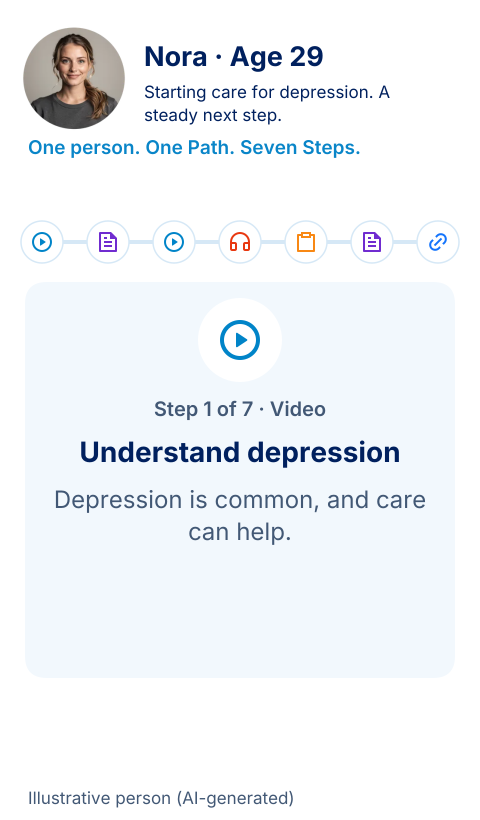
Follow Nora through an illustrative seven-Step Path. A hospital could use this structure to share education its behavioral health team selects, help people prepare for appointments and keep crisis contacts easy to find.
Illustrative person (AI-generated). Illustrative educational Path. Completion does not establish a clinical outcome.
What depression is, that it is common and treatable, and how her care plan fits together.
Her team’s plan in one place: therapy sessions, any medicine instructions and who to contact between visits.
Why treatment can take time, why prescribed medicine often takes weeks to help, and why to talk with her team before starting or stopping anything.
Short guidance on gentle activity, a regular sleep routine and connecting with people she trusts.
Nora prepares notes on her mood, sleep and questions to discuss at her next appointment. The notes are for her visit and are not monitored; for urgent help she uses the crisis contacts in this Path.
A safety plan she writes with her clinician: warning signs, coping steps, people to call and crisis contacts.
Call or text 988 for the Suicide & Crisis Lifeline at any time, and call 911 if she is in immediate danger.
Assign a value to the Understanding Depression Path and see the results.
How many times your team already does this workflow each year.
65.5staff hours saved per year
$2,291estimated value per year
Change the assumptions above to see your estimate of time and money saved.
CREATE
Behavioral health clinicians turn the education they repeat with every new patient into a structured Path and assign it a value of 21 minutes of staff education time saved per patient.
ENGAGE
Each year, 187 patients like Nora begin a depression care plan with the Understanding Depression Path, saving 21 minutes of education time each.
KNOW
That adds up to 3,927 minutes (65.5 hours) of staff time, worth an estimated $2,291 a year at $35.00 an hour.
IMPROVE
Engagement, knowledge checks and questions show where depression education was clear or confusing, so the care team can refine it for the next patient.
Every Behavioral Health Journey Creates an Opportunity to Improve the Next.
Estimates are illustrative and use the assumptions above. They are not measured results.
What begins with a depression diagnosis leads to more than one Path. From understanding depression to meeting her support team, her treatment questions, resources between sessions, practical barriers to appointments, a harder stretch with her safety plan, her check-ins and staying well, Nora needs guidance at every stage. PATHS connects multiple Paths into an experience tailored to her changing needs, and each Path could save the care team time, not only the first. This journey is illustrative.
Nora's care doesn't stop at one Path. As she starts her care plan, the health system provides a Path for each part of it: meeting her support team, understanding depression, her treatment questions, practical barriers to appointments, and resources between sessions. Each Path Nora completes also shows her care team what she engaged with, what she understood and what she still had questions about.
Nora identifies what could get in the way of her planned care. The barriers patients report show the team where to offer practical help.
Nora returns to resources her therapist selected whenever she needs them. The resources patients use most show the team what helps between sessions.
Nora organizes what she wants to discuss at her next contact. That helps the team focus each session on what matters to her.
The more the health system knows about each patient's experience and journey, the better it can make its workflows. What Nora and every other patient engage with, understand and ask about becomes health system intelligence: the team learns from every patient and refines each Path, so the next patient's experience is better. Clearer Paths mean fewer repeat calls and less time re-teaching the same education, and that saves time and money across the health system.
Medical Specialties

Cardiovascular

Neurosciences

Neurosciences

Cancer

Neurosciences
1–6 of 25
Improving behavioral health care doesn't require changing every workflow at once.
Start with a patient journey that matters to your organization. Build a structured approach, understand how patients and caregivers engage, and use what you learn to improve the experience.