


Medical Specialties

Kidney disease can be present before a person knows it.
PATHS helps healthcare organizations turn clinical expertise into actionable patient journeys, giving patients and caregivers clear guidance while providing care teams with visibility into engagement, understanding, and progress.
Kidney disease can be present before a person knows it. Understanding test results and the care team's plan gives patients a clearer way to take part in ongoing care.
37M1
U.S. adults estimated to have CKD stages 1–4 in CDC's 2026 report
87%1
Adults age 20+ with CKD who were unaware of it
41%1
Adults with type 2 diabetes estimated to also have CKD
Ongoing kidney care brings together blood pressure and diabetes management, medicine review, repeat testing and nutrition support. CDC notes that eating plans may need to change as health changes, requiring continuing coordination with the patient's care team.2
Damaged kidneys may no longer clear waste and extra fluid effectively. CDC describes links with high blood pressure, heart disease, stroke and early death. Patients need a plan matched to their stage of kidney disease and other conditions.1
A 2022 Cochrane review found that education may improve kidney-related knowledge and some self-management approaches may improve confidence and physical quality of life. Effects on kidney function were limited or uncertain, and hospitalization data could not be pooled. Better understanding is a realistic goal; fewer admissions cannot be promised.3
Healthcare teams have a critical responsibility to educate and prepare patients for that journey. But once patients leave the clinical setting, how do we know they're ready?
Do they understand their care plan? Can they apply what they've learned? Are they following through? Where do they need additional support?
Preparing patients for the journey is essential. Knowing how they're managing it creates the opportunity to improve care.
Education and knowledge
Help patients understand their clinician's explanation of kidney test results and disease stage.
Tasks, decisions, follow-through
Prepare questions for conversations about medicines, nutrition and future care options.
Medications, appointments, self-care
Organize guidance about the testing and follow-up schedule set by the clinical team.
Assessments and engagement evidence
Check understanding and show where patients or families need further explanation.
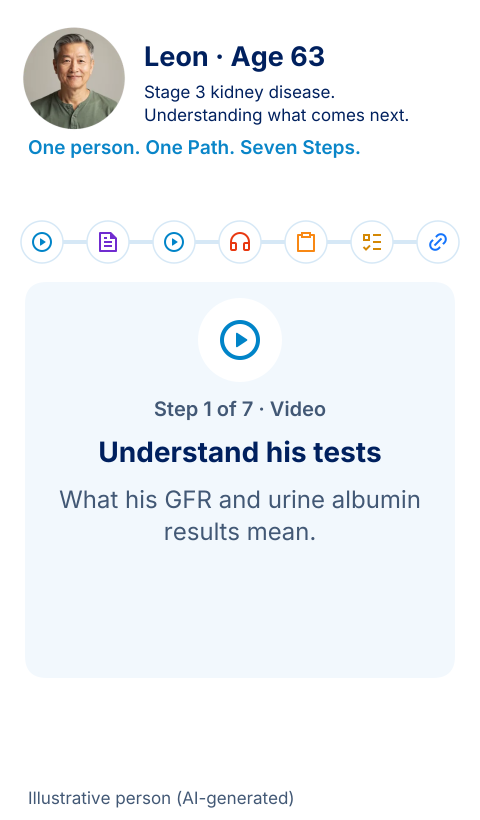
Follow Leon through an illustrative seven-Step Path. A hospital could use this structure to organize education selected by its kidney care team, help patients prepare for nephrology visits and start learning about treatment choices early.
Understanding My Kidney Issues Path
Illustrative person (AI-generated). Illustrative educational Path. Completion does not establish a clinical outcome.
What his GFR blood test and urine albumin results mean, and how his team uses them over time.
His team’s medicine list, and why to ask his team or pharmacist first before taking over-the-counter pain relievers like NSAIDs.
Why the blood pressure and blood sugar goals his team sets help protect his kidneys.
Guidance on sodium, protein and other nutrients, shaped with his dietitian as his needs change.
Leon notes his questions and any changes he has noticed, to bring to his nephrology visit.
Practice which medicines to ask his team about first, and which symptoms to report.
Explore future options, including dialysis types, a transplant and conservative care, to discuss with his team over time.
Assign a value to the Understanding My Kidney Issues Path and see the results.
How many times your team already does this workflow each year.
65.5staff hours saved per year
$2,291estimated value per year
Change the assumptions above to see your estimate of time and money saved.
CREATE
Nephrology clinicians turn the explanation they repeat with every newly diagnosed patient into a structured Path and assign it a value of 21 minutes of staff education time saved per patient.
ENGAGE
Each year, 187 patients like Leon learn about their kidney disease with the Understanding My Kidney Issues Path, saving 21 minutes of education time each.
KNOW
That adds up to 3,927 minutes (65.5 hours) of staff time, worth an estimated $2,291 a year at $35.00 an hour.
IMPROVE
Engagement, knowledge checks and questions show where kidney disease education was clear or confusing, so the care team can refine it for the next patient.
Every Chronic Kidney Disease Journey Creates an Opportunity to Improve the Next.
Estimates are illustrative and use the assumptions above. They are not measured results.
Leon's care doesn't stop at one Path. After his diagnosis, the health system provides a Path for each part of his care: understanding his kidney issues and test results, blood pressure and diabetes, his medicines, and nutrition. Each Path Leon completes also shows his care team what he engaged with, what he understood and what he still had questions about.
Leon prepares questions for a review with his clinician or pharmacist. The questions patients bring show the team which medicine guidance needs work.
Leon can return to the resources his kidney dietitian selected whenever he needs them. The topics patients revisit most show where the guidance can be clearer.
Leon arrives at his review with his questions ready. That helps the team focus the visit on the next stage of his care.
The more the health system knows about each patient's experience and journey, the better it can make its workflows. What Leon and every other patient engage with, understand and ask about becomes health system intelligence: the team learns from every patient and refines each Path, so the next patient's experience is better. Clearer Paths mean fewer repeat calls and less time re-teaching the same education, and that saves time and money across the health system.
Medical Specialties

Cardiovascular
Neurosciences

Neurosciences

Cancer

Neurosciences
1–6 of 25
Improving kidney care doesn't require changing every workflow at once.
Start with a patient journey that matters to your organization. Build a structured approach, understand how patients and caregivers engage, and use what you learn to improve the experience.