



Medical Specialties

Pain can change sleep, work and the activities that make a day feel normal.
PATHS helps healthcare organizations turn clinical expertise into actionable patient journeys, giving patients and caregivers clear guidance while providing care teams with visibility into engagement, understanding, and progress.
Pain can change sleep, work and the activities that make a day feel normal. Care between visits needs to connect the treatment plan with what a person can actually do.
24.3%1
U.S. adults reporting chronic pain in 2023
8.5%1
U.S. adults whose chronic pain frequently limited life or work in 2023
In the 2023 National Health Interview Survey, 24.3% of U.S. adults reported chronic pain. For 8.5% of adults, chronic pain frequently limited life or work activities. The impact extends well beyond the time spent in a clinic.1
The ESCAPE trial combined 12 weeks of medication review and pain self-management with 12 weeks of cognitive behavioral therapy. Nurse care managers delivered the intervention, illustrating the continuing clinical work behind a structured pain program.2
High-impact chronic pain is defined by frequent limits on life or work. Treatment needs to account for function and participation alongside pain intensity; the national survey does not show which limitations are preventable by a particular program.1
In ESCAPE, 241 veterans with chronic musculoskeletal pain were randomized to stepped care or usual care. At nine months, stepped care produced greater improvements in pain-related disability, interference and severity. The program included clinical treatment and therapy, so education alone cannot be credited with those results.2
Healthcare teams have a critical responsibility to educate and prepare patients for that journey. But once patients leave the clinical setting, how do we know they're ready?
Do they understand their care plan? Can they apply what they've learned? Are they following through? Where do they need additional support?
Preparing patients for the journey is essential. Knowing how they're managing it creates the opportunity to improve care.
Education and knowledge
Explain the pain-management options and resources chosen by the person's care team.
Tasks, decisions, follow-through
Help patients prepare goals and questions for conversations about daily function and care.
Medications, appointments, self-care
Keep education about the agreed plan and follow-up available between appointments.
Assessments and engagement evidence
Use assessments and engagement evidence to identify where guidance needs clarification.
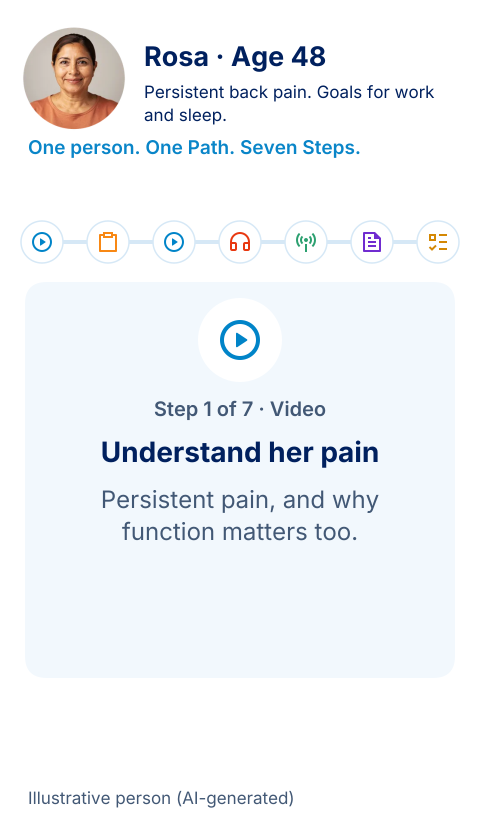
Follow Rosa through an illustrative seven-Step Path. A hospital could use this structure to organize education its pain care team selects, set function goals together and help patients plan for difficult days.
Understanding Persistent Pain Path
Illustrative person (AI-generated). Illustrative educational Path. Completion does not establish a clinical outcome.
How long-lasting pain works, and why her care focuses on daily function as well as pain.
Rosa chooses goals that matter to her, like a full workday or better sleep, to agree with her team.
Exercises from her physical therapist, increased gradually as she is able.
Easing off activities that worsen her pain, then increasing activity gradually as she is able.
A session her care team offers on coping skills such as relaxation and problem solving.
Her team’s plan for flare days: heat or cold, gentle movement instead of bed rest, her medicine instructions and when to call.
Practice which changes to raise at her next visit and which need same-day care, or emergency care if her team’s plan says so, such as new leg weakness, numbness, trouble urinating or fever.
Assign a value to the Understanding Persistent Pain Path and see the results.
How many times your team already does this workflow each year.
65.5staff hours saved per year
$2,291estimated value per year
Change the assumptions above to see your estimate of time and money saved.
CREATE
Pain management clinicians turn the education they repeat with every new patient into a structured Path and assign it a value of 21 minutes of staff education time saved per patient.
ENGAGE
Each year, 187 patients like Rosa start a pain care plan with the Understanding Persistent Pain Path, saving 21 minutes of education time each.
KNOW
That adds up to 3,927 minutes (65.5 hours) of staff time, worth an estimated $2,291 a year at $35.00 an hour.
IMPROVE
Engagement, knowledge checks and questions show where pain education was clear or confusing, so the care team can refine it for the next patient.
Every Chronic Pain Management Journey Creates an Opportunity to Improve the Next.
Estimates are illustrative and use the assumptions above. They are not measured results.
Rosa's care doesn't stop at one Path. As she works with her team, the health system provides a Path for each part of her plan: understanding persistent pain, her goals for daily life, treatment options, movement, and sleep and coping. Each Path Rosa completes also shows her care team what she engaged with, what she understood and what she still had questions about.
Rosa can revisit the movement guidance her rehabilitation team provided whenever she needs it. The steps patients revisit most show the team where the guidance can be clearer.
Rosa identifies work-related needs to discuss with her team. The barriers patients report show the team where to offer practical help.
Rosa tracks daily function and questions between visits. That helps the team adjust her plan around what matters to her.
The more the health system knows about each patient's experience and journey, the better it can make its workflows. What Rosa and every other patient engage with, understand and ask about becomes health system intelligence: the team learns from every patient and refines each Path, so the next patient's experience is better. Clearer Paths mean fewer repeat calls and less time re-teaching the same education, and that saves time and money across the health system.
Medical Specialties

Cardiovascular
Neurosciences

Neurosciences

Cancer

Neurosciences
1–6 of 25
Improving chronic pain care doesn't require changing every workflow at once.
Start with a patient journey that matters to your organization. Build a structured approach, understand how patients and caregivers engage, and use what you learn to improve the experience.