



Medical Specialties
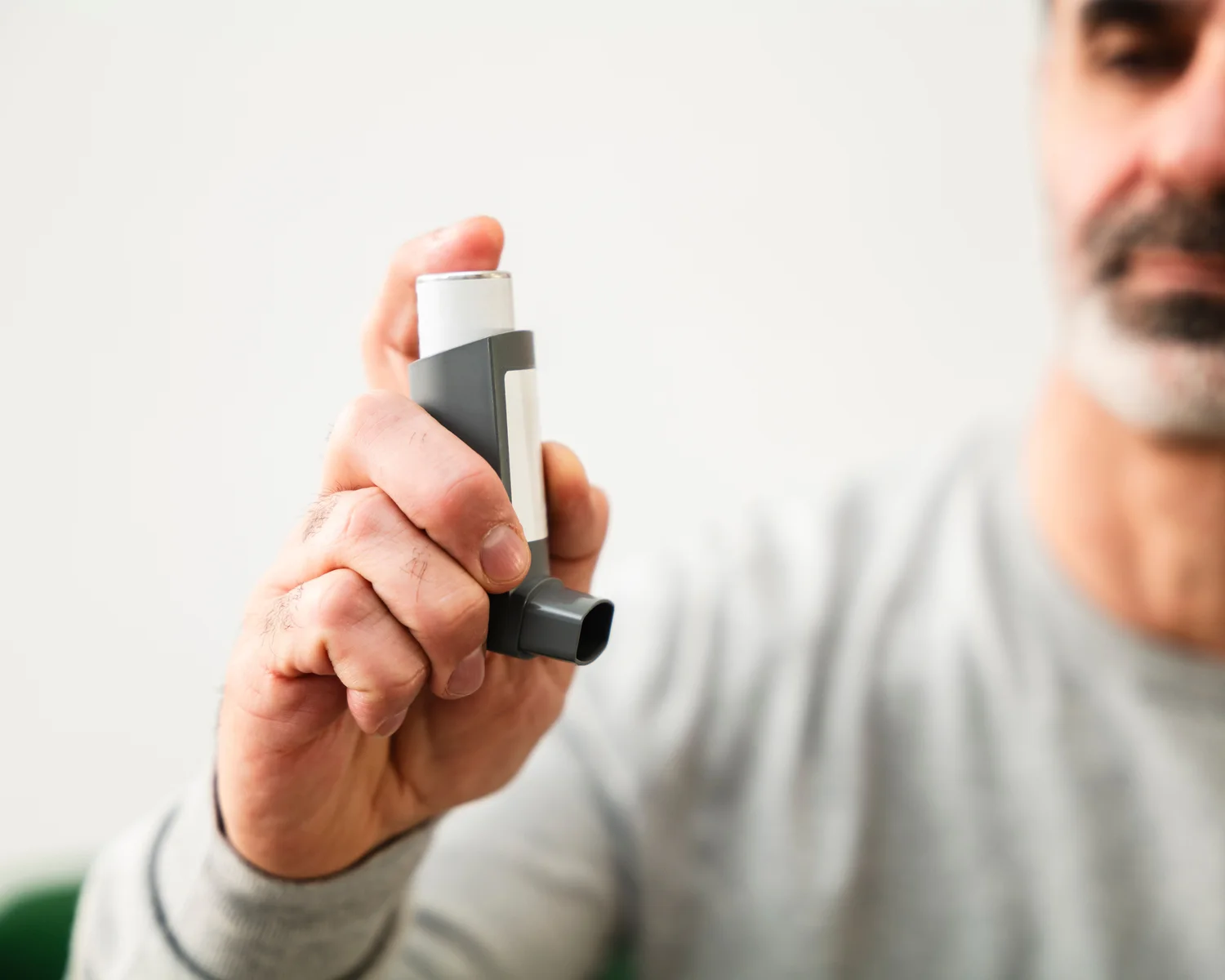
Living with COPD means using inhalers correctly every day, watching for flare-ups, and recovering at home, which can take up to 4 to 6 weeks after a bad one.
PATHS helps healthcare organizations turn clinical expertise into actionable patient journeys, giving patients and caregivers clear guidance while providing care teams with visibility into engagement, understanding, and progress.
Living with COPD means using inhalers correctly every day, watching for flare-ups, and recovering at home, which can take up to 4 to 6 weeks after a bad one. Guidelines call for inhaler technique and adherence to be rechecked regularly, but most of that work happens far from the clinic.2
14.2M1
U.S. adults living with COPD
Nearly 1 in 55
COPD hospital stays followed by a readmission within 30 days
19.4%6
Medicare patients who died within a year of a COPD hospital stay
About 14.2 million U.S. adults have COPD, and chronic lower respiratory diseases were the sixth leading cause of death in 2021. Between visits, patients must take inhalers correctly and spot flare-ups early. Across 54,354 patients with asthma or COPD, only 31% used their inhaler correctly, which is why guidelines call for regular rechecks.1,2,3
Much of the work falls on nurses after discharge. In one U.S. transitional care program for COPD, heart failure and pneumonia patients, a nurse coordinator spent 2 to 4 hours per patient, or 30 to 45 minutes for a phone-only version. The window is tight: 58% of 30-day COPD readmissions happen within 15 days of discharge.4,5
Nearly 1 in 5 patients hospitalized for a COPD flare-up is readmitted within 30 days. COPD is one of six conditions and procedures in Medicare's Hospital Readmissions Reduction Program, which can cut a hospital's Medicare fee-for-service base operating inpatient payments by up to 3%. Among Medicare patients hospitalized for COPD, 19.4% died within a year, and COPD medical costs were estimated at $32.1 billion in 2010, about half paid by Medicare.5,6,7,8
In pooled trials, pulmonary rehab started within 3 weeks of discharge cut the odds of readmission about in half. Among Medicare patients, starting rehab within 90 days was tied to lower 1-year mortality, yet only 1.5% did, even though Medicare Part B covers it for moderate to very severe COPD. Self-management programs with written action plans improved quality of life and lowered the odds of a respiratory hospital admission. These studies evaluated clinical rehabilitation and self-management programs, not PATHS. A Path could make the team's education and agreed action plan easier to revisit between appointments.6,9,10,11
Healthcare teams have a critical responsibility to educate and prepare patients for that journey. But once patients leave the clinical setting, how do we know they're ready?
Do they understand their care plan? Can they apply what they've learned? Are they following through? Where do they need additional support?
Preparing patients for the journey is essential. Knowing how they're managing it creates the opportunity to improve care.
Education and knowledge
Explain COPD and help patients review inhaler education selected by their clinical team.
Tasks, decisions, follow-through
Guide patients through preparation for follow-up and their team's instructions for seeking help.
Medications, appointments, self-care
Keep the agreed action plan, appointment preparation and daily-care education easy to revisit.
Assessments and engagement evidence
Check understanding of inhaler guidance and the action plan so the team can address gaps.
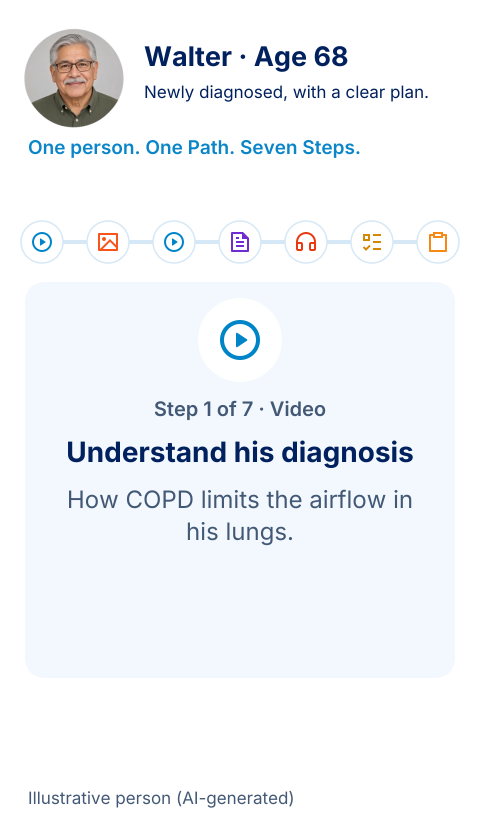
Follow Walter through an illustrative seven-Step Path as he starts care for a new COPD diagnosis. A hospital could use this structure to organize the education its respiratory care team repeats with every newly diagnosed patient, from what the diagnosis means to his questions for follow-up.
Illustrative person (AI-generated). Illustrative educational Path. Completion does not establish a clinical outcome.
What his COPD diagnosis means: damaged airways and air sacs let less air flow in and out of his lungs, and treatment can help, as his care team explains.
A picture guide to spirometry, the breathing test that confirms COPD, with what his own results mean explained by his care team.
Step-by-step technique for the inhaler his team prescribed, then his team checks how he uses it at his next visit.
The action plan he fills in with his care team: his daily treatment, the signs of a flare-up, and when to call his team or 911.
Guided pursed-lip breathing, ways to pace daily tasks, and staying active at the level his team advises, including whether pulmonary rehab is right for him.
Practice which flare-up signs, like more breathlessness or a change in mucus, mean calling his team, and which, like struggling to catch his breath or talk, mean calling 911.
Walter writes down questions for his follow-up visit, such as whether he is using his inhaler the right way and whether pulmonary rehab could help him.
Assign a value to the Understanding My COPD Diagnosis Path and see the results.
How many times your team already does this workflow each year.
65.5staff hours saved per year
$2,291estimated value per year
Change the assumptions above to see your estimate of time and money saved.
CREATE
Respiratory therapists and nurses turn the COPD education they repeat with every newly diagnosed patient into a structured Path and assign it a value of 21 minutes of staff education time saved per patient.
ENGAGE
Each year, 187 patients like Walter learn about a new COPD diagnosis with the Understanding My COPD Diagnosis Path, saving 21 minutes of education time each.
KNOW
That adds up to 3,927 minutes (65.5 hours) of staff time, worth an estimated $2,291 a year at $35.00 an hour.
IMPROVE
Engagement, knowledge checks and questions show where COPD education was clear or confusing, so the care team can refine it for the next patient.
Every COPD & Respiratory Care Journey Creates an Opportunity to Improve the Next.
Estimates are illustrative and use the assumptions above. They are not measured results.
What begins with a COPD diagnosis leads to more than one Path. From understanding his diagnosis to his inhaler, his action plan, pacing activity and breathing, a flare-up, pulmonary rehabilitation and his follow-up visit, Walter needs guidance at every stage. PATHS connects multiple Paths into an experience tailored to his changing needs, and each Path could save the care team time, not only the first. This journey is illustrative.
Walter's care doesn't stop at one Path. After his diagnosis, the health system could provide a Path for each part of his care: understanding COPD, using his inhaler, keeping an action plan, pacing activity and breathing, knowing when to seek urgent help, and pulmonary rehabilitation. Each Path Walter completes also shows his care team what he engaged with, what he understood and what he still had questions about.
Walter can rewatch the technique for his prescribed inhaler whenever he needs it. Knowledge checks show the team which patients may need hands-on review.
Walter practices recognizing severe breathing problems. The answers patients get wrong show which warning-sign instructions need work.
Walter finds his referral and rehabilitation details in one place. Knowing where patients get stuck helps the team connect more of them to rehab.
The more the health system knows about each patient's experience and journey, the better it can make its workflows. What Walter and every other patient engage with, understand and ask about becomes health system intelligence: the team learns from every patient and refines each Path, so the next patient's experience is better. Clearer Paths mean fewer repeat calls and less time re-teaching the same education, and that saves time and money across the health system.
Medical Specialties

Cardiovascular
Neurosciences
Neurosciences

Cancer

Neurosciences
1–6 of 25
Improving COPD and respiratory care doesn't require changing every workflow at once.
Start with a patient journey that matters to your organization. Build a structured approach, understand how patients and caregivers engage, and use what you learn to improve the experience.