

Medical Specialties

Some of the most important decisions in gynecology, from managing heavy bleeding or menopause symptoms to choosing a treatment for fibroids or endometriosis, can't be made in a single visit. Women need time to understand their diagnosis, their options, and what each choice means for their life.
PATHS helps healthcare organizations turn clinical expertise into actionable patient journeys, giving women clear guidance while providing care teams with visibility into engagement, understanding, and readiness to decide.
Whether she is dealing with heavy bleeding, fibroids, endometriosis, a pelvic floor problem, or menopause, a woman has to weigh her symptoms, her options, her future plans, and what each choice means for her daily life. Most of that thinking happens at home, after a visit that rarely has time for every question.
10M+1
U.S. women affected by heavy menstrual bleeding each year
Nearly 1 in 43
U.S. women with at least one pelvic floor disorder (national survey, 2005-2006)
7,6604
Projected U.S. shortage of full-time OB-GYNs in 2038
Gynecologic conditions are common. Heavy menstrual bleeding affects more than 10 million U.S. women each year, endometriosis may affect more than 11% of women ages 15 to 44, and nearly 1 in 4 women have at least one pelvic floor disorder. Many of these conditions have more than one treatment option, and the right choice depends on her symptoms, her history, and her preferences.1,2,3,5,6
A well-prepared decision covers the diagnosis, every reasonable option, what matters most to her, and what comes next. ACOG calls for shared decision-making built on the patient's values and priorities. Doing that well takes time, and OB-GYN time is projected to get scarcer: HRSA projects a national shortage of 7,660 full-time OB-GYNs in 2038, and a 46% shortage in nonmetro areas.4,7
Hysterectomy shows what is at stake. It is the second most common surgery for U.S. women, after cesarean delivery. In a 2015 Michigan study of more than 3,000 hysterectomies for benign conditions, more than a third of women had no documented trial of an alternative treatment beforehand. Nearly 1 in 5 had pathology that did not confirm the condition being treated, a share that was higher among younger women.5,8
A Cochrane review of more than 100 trials found that patient decision aids improve people's knowledge of their options, reduce decisional conflict, and help them take a more active role in decisions. These studies evaluated decision aids, not PATHS. A Path could organize the education and questions selected by the gynecology team.9
Gynecology teams have a critical responsibility to help women make informed decisions. But once she leaves the office, how do we know she's ready?
Does she understand her diagnosis? Does she know every option available to her? Has she thought through what matters most to her? What questions does she still need answered?
Informing her is essential. Knowing what she understands, and where she's still unsure, creates the opportunity to improve care.
Education and knowledge
Help women understand their diagnosis and every option their care team offers.
Tasks, decisions, follow-through
Guide her through what matters most to her and prepare her questions for the next visit.
Treatment, preparation, recovery
Keep education about options, surgery preparation, and recovery in one journey.
Assessments and engagement evidence
Check understanding and decision readiness, and show the team where more support may be needed.
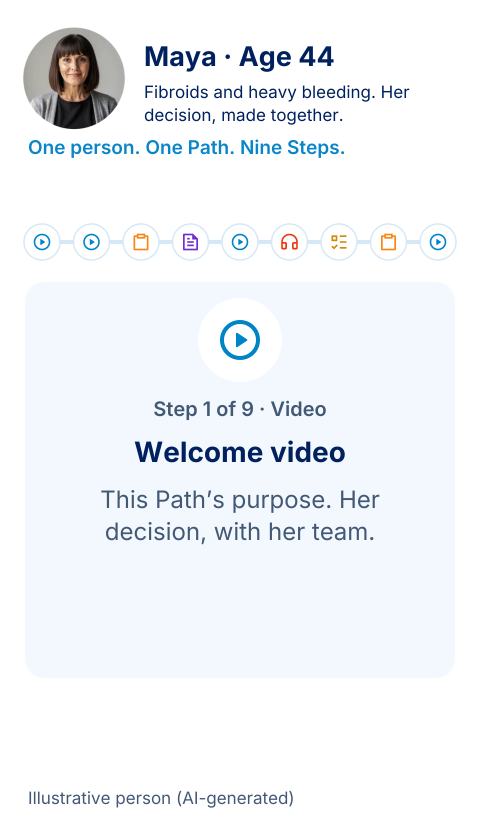
Follow Maya, 44, whose fibroids have caused years of heavy bleeding, through an illustrative nine-Step Path titled "Is a Hysterectomy Right for Me?" A gynecology practice could use this structure to organize education selected by its care team, help her think through what matters most, and bring her to the next visit ready to decide.
Is a Hysterectomy Right for Me? Path
Illustrative person (AI-generated). Illustrative educational Path. This Path does not provide medical advice or recommend a treatment. Completion does not establish a clinical outcome.
what this Path will help her do, that the decision is hers to make with her care team, and that she creates an account before she starts.
why a hysterectomy has come up, and what fibroids, abnormal bleeding, endometriosis, or prolapse mean in plain language.
her symptoms, how they affect daily life, whether she wants a future pregnancy, and her timing and priorities.
the alternatives her care team offers, such as medication, a hormonal IUD, endometrial ablation, uterine artery embolization, myomectomy, or waiting and watching.
types of hysterectomy, surgical approaches, and the question of whether to keep her ovaries, including what surgical menopause means.
time away from work, help at home, physical activity, intimacy, and how she may feel afterward.
a short quiz that shows her, and her team, what is clear and what needs another conversation.
a brief decision-readiness check, where she's leaning, and the questions she wants answered at her next visit, with her signature.
what happens next. Her care team reviews her answers and questions before the visit, so the conversation starts where she is.
Assign a value to the Is a Hysterectomy Right for Me? Path and see the results.
How many times your team already does this workflow each year.
65.5staff hours saved per year
$2,291estimated value per year
Change the assumptions above to see your estimate of time and money saved.
CREATE
Gynecologists and nurses turn the options education they repeat with every patient considering surgery into a structured Path and assign it a value of 21 minutes of staff education time saved per patient.
ENGAGE
Each year, 187 patients like Maya weigh a hysterectomy with the Is a Hysterectomy Right for Me? Path, saving 21 minutes of education time each.
KNOW
That adds up to 3,927 minutes (65.5 hours) of staff time, worth an estimated $2,291 a year at $35.00 an hour.
IMPROVE
Engagement, knowledge checks and questions show where decision education was clear or confusing, so the care team can refine it for the next patient.
Every Gynecology Journey Creates an Opportunity to Improve the Next.
Estimates are illustrative and use the assumptions above. They are not measured results.
Maya's care doesn't stop at one Path. As she decides, her gynecology practice could provide a Path for each part of her journey: understanding her options, preparing for surgery if she chooses it, recovery at home, and her follow-up visit. Each Path Maya completes also shows her care team what she engaged with, what she understood and what she still had questions about.
If Maya chooses surgery, she has her team's preparation instructions in one place. The questions patients ask show which instructions need work.
Maya can revisit what to expect about time off work, help at home and activity. The topics patients revisit most show where the guidance can be clearer.
Maya arrives at her follow-up with her questions ready. That helps the team focus the visit on her recovery.
The more the health system knows about each patient's experience and journey, the better it can make its workflows. What Maya and every other patient engage with, understand and ask about becomes health system intelligence: the team learns from every patient and refines each Path, so the next patient's experience is better. Clearer Paths mean fewer repeat calls and less time re-teaching the same education, and that saves time and money across the health system.
Medical Specialties

Cardiovascular

Neurosciences

Neurosciences

Cancer

Neurosciences
1–6 of 25
Improving gynecologic care doesn't require changing every workflow at once. Start with a patient journey that matters to your organization, understand how women engage, and use what you learn to improve the experience.