




Medical Specialties
Liver disease can remain quiet, then create a complex set of needs.
PATHS helps healthcare organizations turn clinical expertise into actionable patient journeys, giving patients and caregivers clear guidance while providing care teams with visibility into engagement, understanding, and progress.
Liver disease can remain quiet, then create a complex set of needs. Patients and families need to understand their care plan and how to raise concerns as those needs change.
52,2741
U.S. deaths from chronic liver disease and cirrhosis in 2024
33.8%3
30-day readmission rate in a trial of 240 adults with decompensated cirrhosis
32.1%3
Of first readmissions in that trial involved hepatic encephalopathy
In a U.S. cirrhosis trial, case managers called patients weekly for a month. The intervention added coordination of hepatology follow-up, medication use and outpatient fluid-drainage procedures when needed, illustrating the work involved in discharge support.3
In that single-center study, 81 of 240 patients with decompensated cirrhosis were readmitted within 30 days. Hepatic encephalopathy, a complication affecting brain function, was recorded in 32.1% of first readmissions. These rates describe a high-risk study group, not all liver disease.3
The trial did not significantly lower overall 30-day readmissions. An encephalopathy-related result favored the intervention, but the study did not reach its planned sample size. The useful lesson is to make follow-up and escalation clear while treating admission reduction and cost savings as unproven.3
Healthcare teams have a critical responsibility to educate and prepare patients for that journey. But once patients leave the clinical setting, how do we know they're ready?
Do they understand their care plan? Can they apply what they've learned? Are they following through? Where do they need additional support?
Preparing patients for the journey is essential. Knowing how they're managing it creates the opportunity to improve care.
Education and knowledge
Explain the person's liver condition using information selected by their clinical team.
Tasks, decisions, follow-through
Prepare patients and caregivers to ask questions and follow the team's instructions for getting help.
Medications, appointments, self-care
Organize guidance about the agreed treatment plan, daily care and follow-up appointments.
Assessments and engagement evidence
Use assessments to identify questions and gaps in understanding for clinical review.
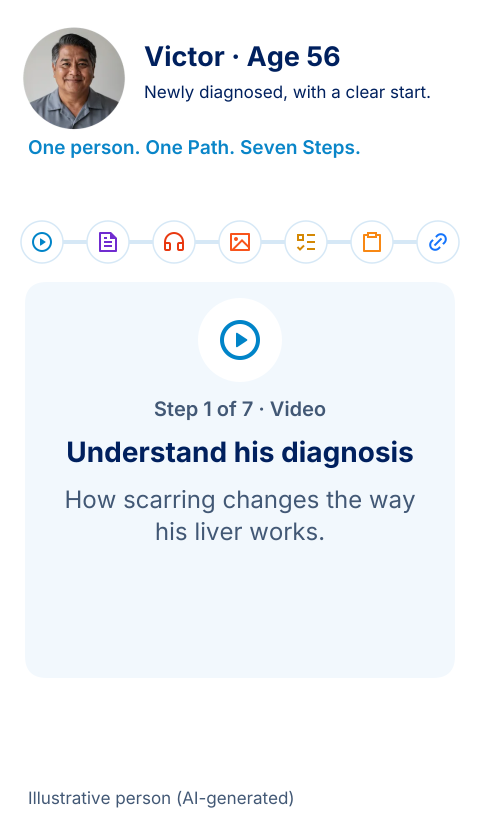
Follow Victor through an illustrative seven-Step Path as he starts care for a cirrhosis diagnosis made during a hospital stay. A hospital could use this structure to organize the education its liver care team repeats with every newly diagnosed patient, from what the diagnosis means to his follow-up plan.
Illustrative person (AI-generated). Illustrative educational Path. Completion does not establish a clinical outcome.
What his cirrhosis diagnosis means: scar tissue has replaced healthy liver tissue, so his liver cannot work normally, as his liver care team explains.
The cause or causes his team found, such as alcohol, fatty liver disease or hepatitis, explained without blame, and why not drinking alcohol protects his liver, with support his team can offer.
Why his team prescribed each new medicine, how to take it as directed, and why to ask his team before taking any other medicine, pain reliever, sleep aid, supplement or herbal product.
A picture guide to the eating plan his team or dietitian advises, such as enough protein, regular meals and a bedtime snack, less salt if advised, and no raw shellfish.
Practice which changes to report to his team, such as more swelling in his belly or legs, and which need help right away: vomiting blood or black stools mean going to a hospital, and new confusion means calling his team at once, as his team instructs.
Victor and his wife write down questions for his first visit after the hospital, such as how advanced his cirrhosis is and which changes matter most.
His follow-up plan: his hepatology visit, the tests and procedures his team schedules, such as a liver ultrasound every six months and an endoscopy if advised, and the vaccines his team recommends.
Assign a value to the Understanding My Cirrhosis Diagnosis Path and see the results.
How many times your team already does this workflow each year.
65.5staff hours saved per year
$2,291estimated value per year
Change the assumptions above to see your estimate of time and money saved.
CREATE
Liver care clinicians turn the cirrhosis education they repeat with every patient into a structured Path and assign it a value of 21 minutes of staff education time saved per patient.
ENGAGE
Each year, 187 patients like Victor learn about cirrhosis after a hospital stay with the Understanding My Cirrhosis Diagnosis Path, saving 21 minutes of education time each.
KNOW
That adds up to 3,927 minutes (65.5 hours) of staff time, worth an estimated $2,291 a year at $35.00 an hour.
IMPROVE
Engagement, knowledge checks and questions show where cirrhosis education was clear or confusing, so the care team can refine it for the next patient.
Every Liver Disease Journey Creates an Opportunity to Improve the Next.
Estimates are illustrative and use the assumptions above. They are not measured results.
What begins with a cirrhosis diagnosis leads to more than one Path. From understanding his diagnosis to his medicines, going home, his nutrition, an endoscopy, symptoms to discuss, liver cancer screening and his hepatology review, Victor needs guidance at every stage. PATHS connects multiple Paths into an experience tailored to his changing needs, and each Path could save the care team time, not only the first. This journey is illustrative.
Victor's care doesn't stop at one Path. After his hospital stay, the hospital provides a Path for each part of his recovery: understanding his diagnosis, his discharge plan, his medicines, appointments and procedures, symptoms to discuss, and nutrition. Each Path Victor completes also shows his care team what he engaged with, what he understood and what he still had questions about.
Victor can return to his prescribing team's instructions whenever he needs them. The questions patients ask show which instructions need work.
Victor's family knows which changes need attention. The questions families raise show the team where the guidance can be clearer.
Victor arrives at his review with his questions and practical obstacles ready. That helps the team focus the visit on his care.
The more the health system knows about each patient's experience and journey, the better it can make its workflows. What Victor and every other patient engage with, understand and ask about becomes health system intelligence: the team learns from every patient and refines each Path, so the next patient's experience is better. Clearer Paths mean fewer repeat calls and less time re-teaching the same education, and that saves time and money across the health system.
Medical Specialties

Cardiovascular
Neurosciences

Neurosciences

Cancer

Neurosciences
1–6 of 25
Improving liver care doesn't require changing every workflow at once.
Start with a patient journey that matters to your organization. Build a structured approach, understand how patients and caregivers engage, and use what you learn to improve the experience.