



Medical Specialties

Maternity care involves changing needs, questions and follow-up during pregnancy and after delivery.
PATHS helps healthcare organizations turn clinical expertise into actionable patient journeys, giving patients and caregivers clear guidance while providing care teams with visibility into engagement, understanding, and progress.
Maternity care involves changing needs, questions and follow-up during pregnancy and after delivery. Families need guidance that fits the current stage and a clear way to reach their maternity team.
8.3%1
U.S. mothers giving birth with gestational diabetes in 2021
CDC reports that 8.3% of U.S. mothers giving birth in 2021 had gestational diabetes, up from 6.0% in 2016. It often has no symptoms, and managing it means following a treatment plan between prenatal visits, including checking blood sugar, being active and eating healthy food at the right times.1,2
Follow-up continues after birth. ACOG and the American Diabetes Association recommend a glucose tolerance test 4 to 12 weeks postpartum for everyone who had gestational diabetes, yet the Society for Maternal-Fetal Medicine reports that postpartum screening rates are typically below 50%. Care teams have to arrange and track that test after delivery.3
Other pregnancy conditions need prompt follow-up too. CDC found hypertensive disorders documented in 15.9% of U.S. delivery hospitalizations in 2019; they are associated with severe complications, including heart attack and stroke. CDC calls for prompt recognition and treatment and for awareness of urgent maternal warning signs. Follow-up must connect concerning symptoms or measurements to a clinical team able to act.4
A 2023 review of 40 studies (17,123 women) found that patient education, one to one with written materials or counselling, or in antenatal groups, was associated with higher attendance at postpartum diabetes screening; evidence for reminders alone was less consistent. Some estimates rest on few trials, and attending a test is not the same as preventing type 2 diabetes. The review was not an evaluation of PATHS. A Path could organize education and agreed next steps around the maternity team's plan.5
Healthcare teams have a critical responsibility to educate and prepare patients for that journey. But once patients leave the clinical setting, how do we know they're ready?
Do they understand their care plan? Can they apply what they've learned? Are they following through? Where do they need additional support?
Preparing patients for the journey is essential. Knowing how they're managing it creates the opportunity to improve care.
Education and knowledge
Help patients understand the guidance their maternity team provides during pregnancy and after birth.
Tasks, decisions, follow-through
Prepare questions for visits and review the team's instructions about when and how to seek help.
Medications, appointments, self-care
Connect education about prenatal visits, birth preparation and postpartum follow-up.
Assessments and engagement evidence
Check understanding and help the team see where patients need more explanation or support.
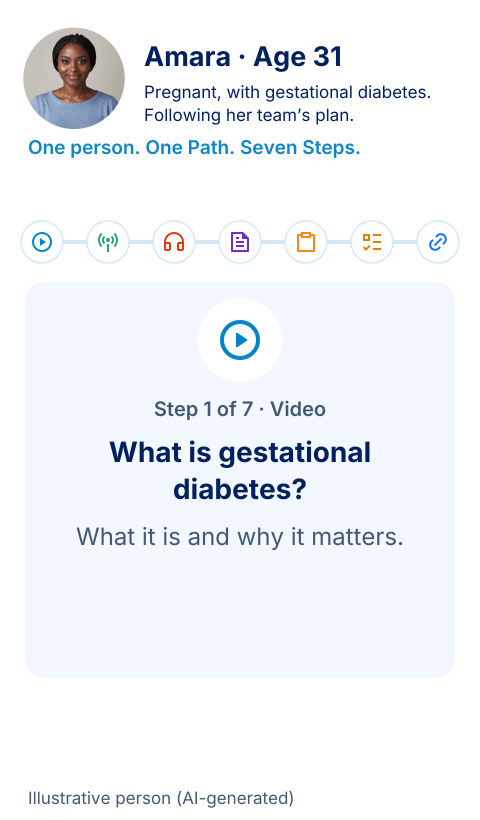
Follow Amara through an illustrative seven-Step Path. A hospital could use this structure to share gestational diabetes education its maternity team selects, help her bring glucose readings and questions to her prenatal visits and make urgent warning signs easy to recognize.
Understanding My Gestational Diabetes Path
Illustrative person (AI-generated). Illustrative educational Path. Completion does not establish a clinical outcome.
What gestational diabetes is, why pregnancy hormones can raise blood sugar, and why following her team’s plan matters for her and her baby.
A session her maternity team offers on regular meals and snacks, following the meal plan her team or dietitian sets for her.
Short guidance on staying active in pregnancy, such as walking, in the type and amount her team agrees is right for her.
How to check her blood sugar with her meter, only at the times and in the way her team instructs, and which readings her team wants her to report.
Amara records her readings in the log her team asks for and notes questions to bring to each prenatal visit; the log never replaces calling her team.
Practice which changes mean calling her team, such as readings her team asked her to report, and which urgent warning signs, such as a headache that won’t go away, vision changes, chest pain, trouble breathing or her baby moving less, mean getting care right away and saying she is pregnant.
Her postpartum visit details and the follow-up glucose test her team recommends after birth, because gestational diabetes raises her chance of diabetes later, with questions to bring.
Assign a value to the Understanding My Gestational Diabetes Path and see the results.
How many times your team already does this workflow each year.
65.5staff hours saved per year
$2,291estimated value per year
Change the assumptions above to see your estimate of time and money saved.
CREATE
Maternity nurses and diabetes educators turn the gestational diabetes teaching they repeat with every patient into a structured Path and assign it a value of 21 minutes of staff education time saved per patient.
ENGAGE
Each year, 187 patients like Amara learn about gestational diabetes with the Understanding My Gestational Diabetes Path, saving 21 minutes of education time each.
KNOW
That adds up to 3,927 minutes (65.5 hours) of staff time, worth an estimated $2,291 a year at $35.00 an hour.
IMPROVE
Engagement, knowledge checks and questions show where gestational diabetes education was clear or confusing, so the care team can refine it for the next patient.
Every Maternal & Prenatal Care Journey Creates an Opportunity to Improve the Next.
Estimates are illustrative and use the assumptions above. They are not measured results.
Amara's care doesn't stop at one Path. From pregnancy to the weeks at home, the health system provides a Path for each part of her care: understanding gestational diabetes, her maternity team, prenatal visits, preparing for birth, and postpartum follow-up. Each Path Amara completes also shows her care team what she engaged with, what she understood and what she still had questions about.
Amara prepares her questions before each appointment. The questions patients bring show the team which topics need clearer teaching.
Amara reviews her postpartum appointments and support before she goes home. The steps patients revisit most show where the guidance can be clearer.
Amara knows her contact plan after delivery, including any follow-up testing her team recommends. Knowing where patients get stuck helps the team keep more of them connected to follow-up.
The more the health system knows about each patient's experience and journey, the better it can make its workflows. What Amara and every other patient engage with, understand and ask about becomes health system intelligence: the team learns from every patient and refines each Path, so the next patient's experience is better. Clearer Paths mean fewer repeat calls and less time re-teaching the same education, and that saves time and money across the health system.
Medical Specialties

Cardiovascular

Neurosciences

Neurosciences

Cancer

Neurosciences
1–6 of 25
Improving maternal and prenatal care doesn't require changing every workflow at once.
Start with a patient journey that matters to your organization. Build a structured approach, understand how patients and caregivers engage, and use what you learn to improve the experience.