



Medical Specialties

A treatment plan can involve movement, sensation, fatigue or thinking, with very different needs from one person to the next.
PATHS helps healthcare organizations turn clinical expertise into actionable patient journeys, giving patients and caregivers clear guidance while providing care teams with visibility into engagement, understanding, and progress.
A treatment plan can involve movement, sensation, fatigue or thinking, with very different needs from one person to the next. Progress depends on understanding those needs beyond the exam room.
180.3M1
U.S. people estimated to have a condition affecting nervous system health in 2021
57.7M1
U.S. people estimated to have migraine in 2021
77%2
Recommended care indicators met with nurse-led Parkinson's care, versus 58% with usual care
A U.S. Global Burden of Disease analysis estimated that 180.3 million people had a condition affecting nervous system health in 2021. That broad definition includes headaches, neuropathy and nervous system effects of other illnesses, as well as neurological diagnoses.1
In a randomized trial of 328 veterans with Parkinson's disease, nurse-led care management required more telephone contacts than usual care. Tracking symptoms, care needs and follow-through was part of a staffed clinical program.2
The national analysis estimated 16.6 million disability-adjusted life-years lost to conditions affecting the nervous system in 2021. These conditions can affect daily function for years, so a single appointment cannot describe the whole care journey.1
The Parkinson's trial increased delivery of recommended care: 77% of care indicators were met, compared with 58% under usual care. Only one of eight secondary patient outcomes improved significantly. This supports more consistent follow-up without promising better outcomes across every neurological condition.2
Healthcare teams have a critical responsibility to educate and prepare patients for that journey. But once patients leave the clinical setting, how do we know they're ready?
Do they understand their care plan? Can they apply what they've learned? Are they following through? Where do they need additional support?
Preparing patients for the journey is essential. Knowing how they're managing it creates the opportunity to improve care.
Education and knowledge
Explain the person's diagnosis and the care options described by their neurological team.
Tasks, decisions, follow-through
Help patients prepare goals and questions about symptoms, daily life and treatment.
Medications, appointments, self-care
Keep the agreed care-plan education and appointment preparation available to patients and caregivers.
Assessments and engagement evidence
Use assessments to identify gaps in understanding and questions the team should address.
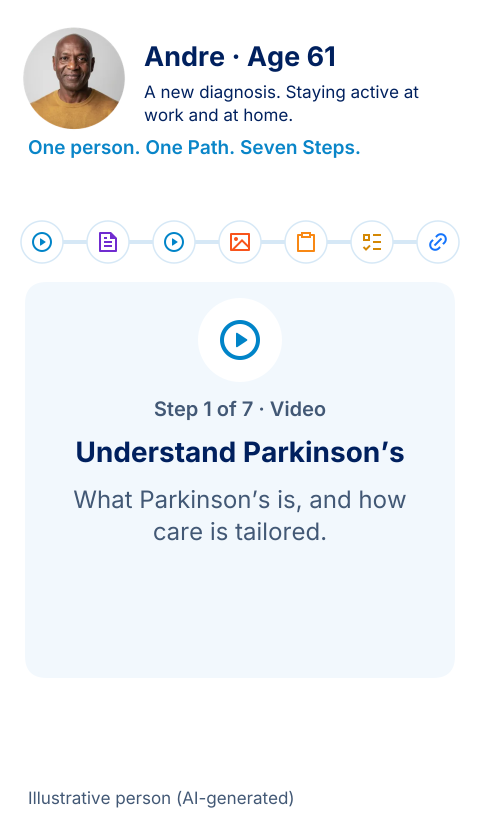
Follow Andre through an illustrative seven-Step Path. A hospital could use this structure to organize education selected by its neurology care team, help patients prepare for visits and connect them with therapy and community support.
Understanding My Journey Ahead Path
Illustrative person (AI-generated). Illustrative educational Path. Completion does not establish a clinical outcome.
What Parkinson’s is, how symptoms differ from person to person, and how his team tailors care.
His team’s medicine schedule, why timing matters, and which side effects to report.
Why regular exercise matters in Parkinson’s, starting with the plan from his physical therapist.
A room-by-room picture of fall-prevention ideas, like clearing clutter, grab bars and night lights.
Andre notes changes in movement, sleep, mood and work, and the time of day they happen, for his next visit.
Practice which changes to raise at his next visit and which to report to his team right away.
Find exercise classes, support groups and resources for working with Parkinson’s.
Assign a value to the Understanding My Journey Ahead Path and see the results.
How many times your team already does this workflow each year.
65.5staff hours saved per year
$2,291estimated value per year
Change the assumptions above to see your estimate of time and money saved.
CREATE
Neurology clinicians turn the education they repeat with every newly diagnosed patient into a structured Path and assign it a value of 21 minutes of staff education time saved per patient.
ENGAGE
Each year, 187 patients like Andre learn what to expect with Parkinson's disease with the Understanding My Journey Ahead Path, saving 21 minutes of education time each.
KNOW
That adds up to 3,927 minutes (65.5 hours) of staff time, worth an estimated $2,291 a year at $35.00 an hour.
IMPROVE
Engagement, knowledge checks and questions show where Parkinson's education was clear or confusing, so the care team can refine it for the next patient.
Every Neurological Disorders Journey Creates an Opportunity to Improve the Next.
Estimates are illustrative and use the assumptions above. They are not measured results.
Andre's care doesn't stop at one Path. As he adjusts, the health system provides a Path for each part of his care: understanding the journey ahead, his neurology team, his treatment, movement and daily tasks, noticing changes, and work and home. Each Path Andre completes also shows his care team what he engaged with, what he understood and what he still had questions about.
Andre can revisit the rehabilitation guidance chosen for him whenever he needs it. The steps patients revisit most show where the guidance can be clearer.
Andre organizes his observations about symptoms for his next visit. The changes patients report help the team see who may need support sooner.
Andre arrives at his appointment with his questions and observations ready. That helps the team focus the visit on what matters to him.
The more the health system knows about each patient's experience and journey, the better it can make its workflows. What Andre and every other patient engage with, understand and ask about becomes health system intelligence: the team learns from every patient and refines each Path, so the next patient's experience is better. Clearer Paths mean fewer repeat calls and less time re-teaching the same education, and that saves time and money across the health system.
Medical Specialties

Cardiovascular
Neurosciences

Neurosciences

Cancer

Neurosciences
1–6 of 25
Improving neurological care doesn't require changing every workflow at once.
Start with a patient journey that matters to your organization. Build a structured approach, understand how patients and caregivers engage, and use what you learn to improve the experience.